My Actual Homepage - Go here for more info.


I plan to put a graphical banner here eventually...

28 March 2009

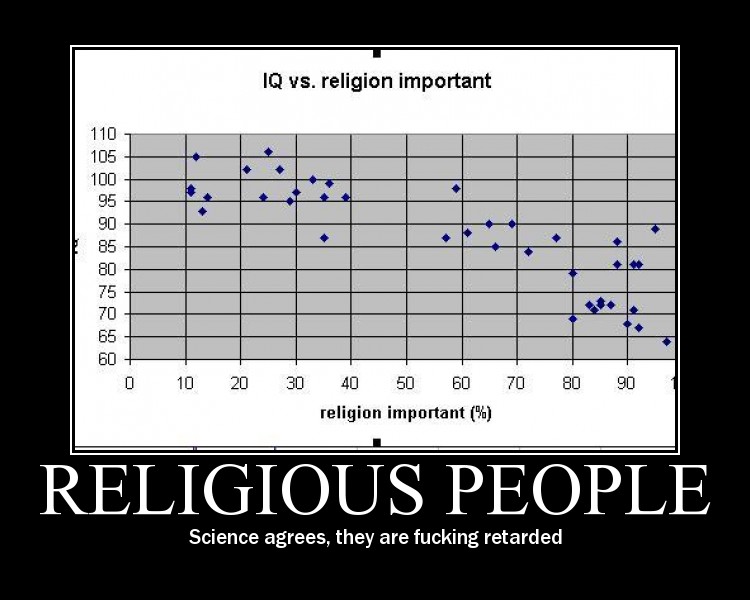
Texas: Sofa King Retarded


Dr. Phil Plait has a summary of the TRAVESTY that happened in Texas (and apparently Florida is attempting to follow suit). Basically the LYING young earth creationist got their language into the educational standards... I am amazed at how blatantly these people will LIE and DECEIVE to push their bronze age fairy tale agenda.

Here is Dr. Plait's, write up on the topic. As he says, I urge all parents who live in reality to get involved with their education board, and keep their children in THIS century, and not back in the dark ages.

I am so mad that I can barely type without wanting to go on a murderous spree of eliminating these dangers to humanity and reality... Just read Dr.Plait's posts. He says it well.

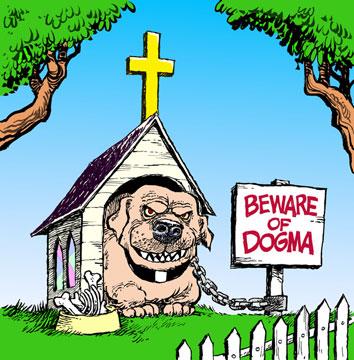
And the "humerous" picture up above... Well, suffice it to say that I really feel there is a lot of validity to it. Sorry, it may be harsh, but all evidence points to it. Especially with the fucktardery going on with our education system and the destruction of our children's futures. Only a fucking retard would willingly handicap the future of their offspring, and that's what these retards are doing.

23 March 2009

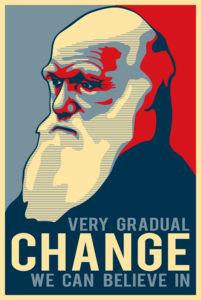
Evolution Doesn't have a Goal


Usually the objections to evolution I encounter when discussing the subject with a creationist are based in misunderstanding of what evolutionary theory is, what it actually states and what it does not. Commonly the objections are nothing more than a straw man fallacy.

Straw man fallacy:
“A straw man argumentis an informal fallacy based on misrepresentation of an opponent's position. To "attack a straw man" is to create the illusion of having refuted a proposition by substituting a superficially similar proposition (the "straw man"), and refuting it, without ever having actually refuted the original position.”

For example I commonly hear things such as, “How could an eye just pop into existence”. If evolutionary theory stated that something as complex as an eye could just “pop into existence”, then it clearly would be a ridiculous theory. However the theory does not claim anything like that, and this is a typical straw man fallacy born out of misunderstanding and ignorance.

I will attempt to simply what evolutionary theory does state, and what it does not with regard to common misconceptions I have heard.

Misconception of Evolution having a goal.
Misconception of species changing rather than splitting.
Misconception of Micro Evolution.
Misconception of intermediate forms.

I have started with the misconception of Evolution having a goal because I believe it will be a good place to cover the basics and clear away some extremely common misconceptions which hinder any further learning if they are in place.

Evolution via Natural selection is essentially made up by two important facts. Variety among individuals, and selection pressures on reproduction. To put it simply, if one individual is better equipped to breed than another, the chances that it will breed are higher than the other less well equipped individual. For example a fast and strong cheetah has a much better chance of surviving than a slower and weaker cheetah does. The faster and stronger cheetah is likely better at catching it's prey, it therefore will have a better chance of staying alive longer than a cheetah who is failing to catch its prey, and therefore starving. The physical variation between the two differentiate how successful they are likely to be at surviving in a competitive environment. If the weaker cheetah dies of starvation at a young age, it is unlikely to have bred and it is therefore unlikely to have passed on its genes to offspring. The strong cheetah however, which is living a long successful life may have bred many times, producing offspring which contain the successful genes which made it strong and fast.

Lets rewind here a second however. What would make one cheetah strong, and one weak, and where does this variation among individuals come from?

Every individuals body is made using a DNA recipe which is unique to that individual. DNA – Deoxyribonucleic acid - is essentially a very long molecule which interacts with other molecules/chemicals to form a chain reaction of physical processes which build bodies. Bodies are made of cells, which contain the DNA recipe within them (in the nucleus). These cells must replicate in order to form large and complex bodies made up of billions of them. It is useful to think of your DNA as a recipe for building your body, not as a predefined plan or blueprint.

Everyone's DNA varies because when the DNA replicates itself to build cells, the physical process can go slightly wrong, and the replication is not perfect. You and your next door neighbors DNA varies by about 3 million differences in the DNA recipe.
You have about 3 billion bits of code in your recipe. If your neighbor had the exact same 3 billion characters in their DNA recipe, the physical process of building the body from the recipe would happen the same way as yours, and you would look identical. This is not the case though because changes in the recipe happen randomly, and regularly, and your DNA took a different journey through your ancestors to end up with you. When your mother and your father's DNA combine to create your DNA, your DNA contains copies of genes they both posses which make them different individuals (Roughly 50% from your mother and 50% from your father). This newly combined DNA contains differences that were passed down from past ancestors via your mothers lineage, and via your fathers lineage. This is what enables your parents to have variance in their own DNA recipes. In addition to this, the newly combined DNA that forms you, will also contain mutations that have occurred in your mother and fathers own DNA since it was first combined from their mother and father.

So going back to the cheetahs, if a mutation happens in part of the DNA recipe which dictates how the chain reaction of physical process will work to build leg muscles, then the legs will be built differently between two individuals with different DNA recipes. The different DNA recipes built a cheetah with strong fast legs, and a cheetah with slower weaker legs. Mutations can also occur to the parts of the DNA recipe which govern how and when a particular part of the recipe (a specific gene, which encodes a specific protein) is used and for how long. We can see dramatic difference in individuals just by using the same ingredients in the recipe for different lengths and at different times.

So as we can see, variation among individuals arises purely as part of the physical processes which build life.

The next important part is the selection of which variety of individual will pass on their variation of the DNA recipe, and which will not. It is quite easy to understand. Those which have variations which make them better able to survive, or out compete other individuals, will have a better chance of producing offspring. (like in our cheetah example)

You can easily see how different environments would favor different variations and place different selection pressures on individuals. For example in a cold environment those with thicker fur will have less chance of dying from exposure, and therefore a greater chance of surviving and reproducing. Or in a desert those who can store energy more efficiently will have less chance of dying of thirst or starvation. Selection is not random, and is in fact quite predictable .
So we could say: Variation is random, selection is non random.

So to get to the misconception of evolution having a goal; given what we know about how the process works, we can see that there is no goal for evolution or no end point that a species is trying to get to. Evolution happens simply because environments select for those traits in individuals that are going to more successful than those that are not in the current environment. A species group living 60 million years ago did not have a goal to try and evolve to become like a modern organism living now. Any single living thing is just trying to make a living at whatever time it is alive. It is the varying success of traits that will drive a change over time, not any type of goal or desire to change.

Evolution is not a march of progress in a defined direction, it is simply a natural response to varying environmental pressures placed on living organisms which replicate themselves.
So when we find a fossil of an extinct animal which is vastly different to a modern animal and evidence suggests that the extinct animal was once an ancestor of a currently living animal. We should not view it as if the extinct animal and all its descendants had a goal in mind of trying to morph into the modern form we recognize around today. We should view it as all the millions of descendants had variations that were selected for in various environments because the variation allowed that particular ancestral individual to successfully mate, and pass on the successful variant. It is useful not to think of living organisms as species of distinct groups of animals, but as collections of traits (or genes). Traits that were able to be passed down in varying environments because some traits suit some environments better than others.

Edited to add: Technically, there's really no such thing as "species," that's just how we categorize animals with similarities.

Imagine a color spectrum. At what point does red become orange? It's an arbitrary distinction made for convenience. All organisms evolve smoothly, there's no point at which one becomes another, just like you can never show the "transitional" point between red and orange.

This is why the creationist's hunt for a transitional species is a red herring. Either nothing is a transitional species, or everything is a transitional species. When scientists use that term, they're talking about filing in massive gaps of morphology in the fossil record. But if you had a sample of every animal that ever existed it would look like an extended version of a color spectrum. Imagine twenty feet of colors between aqua and blue-green.

http://www.vtutorials.com/curefaith/micro-vs-macroevolution.html

13 March 2009

Three Simple Words (Pt. 2)


It's much better to change your point of view in response to reality, than to insist reality has got it wrong because it doesn't share your point of view.

Okay, I covered “I don’t know” briefly, but along with those three words are three that people seem even more loath to say. “I was wrong.” And when someone does figure out that they are indeed wrong, and that perhaps something else is a better answer, we have people jumping on that as some sort of mortal flaw. Being occasionally wrong, or not totally correct, is how things like science and technology gets better. Even a field like chemistry got its start in the ridiculous notion of alchemy. Yet, for all the mistakes one can historically cite in science, how many of them were brought to light through theology? Not a one. It was the self correcting mechanism of science that exposed the mistakes, and then proposed a better conclusion.

Religious scholars have a conclusion and build the evidence up to support it. Science has the evidence and builds a conclusion out of it. Then (and this is the important part), scientists do everything they can to try to disprove the conclusion. I have yet to meet a physicist who wouldn't love to be the one to show that Einstein or Hawkins' theories were garbage and here is the correct model. I have yet to meet a christian theologist who wanted to show that those Moses and Jesus guys didn't know what they were talking about and here is the correct theology.

Of course, theists don’t seem to take so kindly to scientific methodology applied to their claims. By definition, in order to hold those beliefs, they are not even allowed to contemplate that those beliefs may be wrong. Since they have no avenue to point out mistakes in their theology, they keep jumping on the bandwagon of pointing out every mistake ever made in the field of science, while they fail to grasp that not once did they actually contribute to the field. Yet the mistakes themselves were all part of the overall improvement. They will gladly enjoy the benefits, but at the same time spend all their energies on tearing it down.

So, in refusing to consider “I don’t know” and “I was wrong” into their lexicon, theists have doomed themselves into a mental dissonance that makes them challenge reality on a daily basis. It’s like science is a bold voyage to find out the unknown, with lessons in humility at every step. Yet these people so sure in their version of The Truth, would rather just have stayed home. The methods of science may not be perfect, but they are the best we have. To embrace dogma and throw away skeptical inquiry will just lead to a dark age in our history. The basic reaction of a theist to anything that challenges their belief is to suppress the idea. To a scientist, they discuss the idea and completely expose it the full rigor of science, and form a better idea.

I guess what it all comes down to, is that all that talk about having science and biblegod coexist really can’t happen. The basic starting positions are diametrically opposed. The methodologies are the inverse of each other. The fundamental claims do not in any way match. I contend (to paraphrase Carl Sagan) that it’s far better to really see the universe for what it is than to persist in delusions, no matter how comforting those delusions may seem. I don’t want to have meaning assigned to me; I would rather make meaning myself. Especially if the assigner is that biblegod bastard. I know I can do a whole lot better than him!

08 March 2009

Networking?


Is it really possible to do the type of networking that I have been told over and over again you need to do in order to land a job, and do it from overseas? While I do everything that I can using my Facebook page and my LinkedIn profile, I gotta say that I am even all the more upset with the Air Force for this deployment... The #1 message that they drill into you at the Transition Assistance Program is that you have to network, network, and network some more... Well, there is nothing that can substitute for meeting face to face and talking to a person.

With all the talk of "People are our number one resource." and "We take care of our people." does the AF insist on pulling douchebaggery like this? Of course, I have always thought that those sayings are just words to them that really have very little actual meaning. Sure, there are services set up for people, but in everything I have seen, if it's something that really means taking care of people, the AF is just going through the motions at best. In many cases, I see things that are meant to help people actually act as a detriment to their careers and security clearances. They SAY that these things have no effect on that, but then why does the preponderance of evidence show people suffering for taking advantage of these services.

So yet again, the message that gets driven home to me at least is that no one in the AF cares, nor will they even try to do what is right for you. The only person you can really rely on in the AF is yourself.

Now, I am not so bitter as to think this doesn't happen in the civilian sector. In ways, I am betting that the back stabbing and douchebaggery is probably much worse. It's just in the AF, the consequences can sometimes be much more lethal.

Okay, that felt better to get off my chest. I'm still not happy with the treatment I have received at the hand of bureaucratic pinheads, but I'll fight through it and make my way on myown, despite their best efforts, and in no way because of them.

01 March 2009

Three Simple Words (Pt. 1)

"Faith does not give you the answers; it just stops you asking the questions." - Frater Ravus

Quite often when having “discussions” with theists[i], I get the accusation that I “know it all”, or something to that effect. While I do admit to having a good education, and that I spend a great deal of time self educating myself on various subjects, I by no stretch of the imagination know it all. This claim by theists bothers me tremendously due to how disingenuous that claim is.

First of all, if my display of knowledge and intellectual curiosity makes them genuinely think that I know it all, then I feel sad for them and the ignorance that they live in. Not only for their lack of education, but lack of curiosity to actually go and find out things they may not know or understand. In this day and age, we have unprecedented access to information. Some of it good, a lot of it bad. However, being able to wade through all this information, and weigh its validity only helps to sharpen the mind, as well as expand your horizons. Something that is of great help in this is having a “Baloney Detection Kit” as Carl Sagan often referred to it as. The James Randi Educational Foundation also has a great exposé on the sort of Flim Flam that people get duped into believing. Finally, there is a great video for people who want to sharpen their thinking skills called “Here there be Dragons”. It’s free and educational. Instead of accusing me of knowing it all, how about actually taking the initiative to learn something?

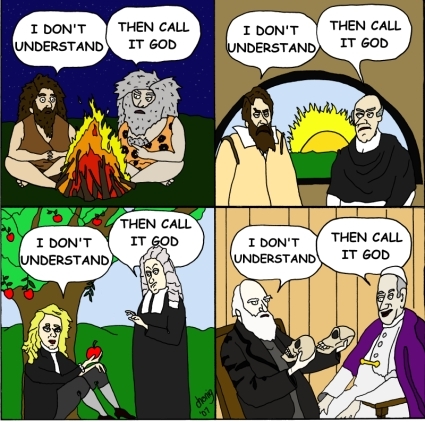
Another thing that really bothers me about the claim that I supposedly know it all, is that the theist making that claim usually then proceeds to act humble and simple, as if to make me appear to be acting all superior to them. What makes this behaviour particularly disingenuous is that first of all I am not claiming any special knowledge that has been revealed to me. Also, the debate is generally about things that we don’t know the answer to, such as the origin of life, or even the origin of the universe. We have theories and ideas about these things, but in reality we don’t know, and perhaps won’t know beyond a shadow of a doubt. Yet, to the theist, some Bronze Age tales from primitive goat herders does provide them with those answers, even if those answers don’t make any sense and are just revealed truths through third hand sources. Apparently, to a theist, even a bad explanation is better than admitting that we don’t know the answer?

Hence why I really think that “I don’t know” are three incredibly powerful and liberating words. We can naturally follow it up with, “But this is what we think” about a subject. Or even go so far as to say, “I don’t know, but that’s a great thing to find out more about!” By claiming to have some sort of revealed TRUTH, the theist ceases at any line of questioning. They have the answer already, no need to actually check if it makes any sense. Whereas someone who displays any modicum of intellectual curiosity isn’t satisfied with nonsense and flim flam. By saying “I don’t know” you free yourself from dogmas and rigid beliefs that have only been drummed into you because it says so in the bible or whatever source you place your “faith” in. By saying “I don’t know” it should motivate you to find out what the real answer may be. And don’t be the kind of skeptical thinker that thinks dismissing anything you don’t agree with qualifies as skepticism, that’s just being dismissive and contrary. Instead, start off in a neutral stance, and see where the evidence leads you. Don’t confuse trust for faith either. Again, all things referenced in the Baloney Detection Kit and Here there be Dragons resources can help.

Many may argue that there is no harm in holding beliefs. To a certain extent, that is true, and I will not deny it. However, the lack of knowledge, combined with a willingness to accept whatever they are told, can lead to a great deal of harm. I also find it distasteful how many theists will pick and choose what they are willing to know, and again don’t apply any skeptical thought to the source. They already have the conclusion set out for them, and continue on forcing reality to meet that expectation. As such, they are defeating any natural skepticism that may be in their minds because they will never need to say “I don’t know” in response to hard questions. And since they think they have The TRUTH already, that basically leads them to never even consider three other powerful words, “I was wrong.”


[i] When I say “theists” I am generally describing the fundamentalist or evangelical christian mindset. They are the worst offenders in this type of thinking; however they are not the only ones, so I expanded the word I used.

13 February 2009

Fighting the Party, not Ideas


Maybe I am just fed up with the current US political system. It seems to me that people on "The Hill" aren't fighting the ideas they put forth, but rather just fighting each other. The basic core of their ideas seem so similar that I can't help but to think they are out of original ideas! In this day and age, the battle lines are clearly drawn strictly by political affiliation. And they don't even attack the ideas that are presented except on minute differences that have no real bearing on the overall gist of the idea. Instead they spew forth terms lie "The Democrats" or "The Republicans" without examining what it is that they are attempting to accomplish!

I see this as a symptom of what is really at the heart of the broken aspects of the two party system. There is no incentive to build a coalition. It's down to an all or nothing system. It's all the same ideas with different banners and bumper stickers. Perhaps the American public is satisfied with this?

I do tend to wax philosophical from time to time about the overall stupidity of the American public, and with them getting suckered in to this fight over slogans just seems to confirm my worst opinions of "people" in general. What I'd like to see are substantive debates on the ideas and issues, not window dressing cat-fights. And as George patton once said, "If everyone is thinking alike, no one is really thinking." It seems that they have sold off their intellectual capabilities for just attacking the other party because they are the other party, and nothing more.

If a candidate wants my vote, they must show several items, and none of them have any basis in any party. They need to first of all show intelligence! Some claim that being an elitist is a bad thing, but dammit, we are expecting this person to run the most powerful nation on earth. I damn well expect them to be elite! I don't want an average brain surgeon or average mechanic either. I want the best, and that should go for the President or any other elected official. I want them to be responsible. Not only in their actions, but for their ideas and mistakes. The idea of passing the buck has become so ingrained in today's society that it's almost startling when someone owns up as says they screwed up. I want them to exhibit some imagination! I think that's probably a deal breaker for most politicians. The inertia of doing things the same old way has totally stifled Washington.

Well, just my thoughts for today. What do you think?

10 February 2009

Characteristics of Dogma in Conspiracy Therorists and Religion


Dogma may be defined as established opinion, a doctrine put forth without evidence, or as a body of doctrines supported authoritatively by a church. But when you consider a combination of all three--an established opinion without evidence, supported by the authority of supernatural beliefs--you have a summation of everything that good science is opposed to. As it so happens, religion is the largest central distributor of dogma, but you can find it within other circles of opinion as well.

Theology is defined as "faith justified by reason." But this is another way of saying "A conclusion in search of a justification." This was the dominant philosophical approach of the dark ages, and it was this habit that kept them in the dark. Beliefs were fortified and communicated, supported only by citations of other beliefs, forming a circle of opinion with no means of objective correction. Theology remained a circle jerk, somewhat like partisan bloggers, who reinforce their mutual preconceptions by echoing them back and forth, referencing each other, accepting only what evidence confirms their beliefs and ignoring the rest (when they reference evidence at all.) This is the modus operendi of dogmatists, and it can become a prison which is difficult escape. This is what made science impossible in the dark ages, and it was only when a central dogmatic authority of the Catholic Church was shattered that science and philosophy could flourish.

This same hermetically sealed community of belief can also be found amongst political ideologues, proponents of various pseudo-sciences and occult dogmas, and amongst conspiracy theorists. Conspiracy theorists are notorious for this tendency to form communities of the deluded, for in their case the opinions they hold are often so outrageously wrong that conspiracists often appear genuinely insane. The internet has been instrumental in the rise of new conspiracy theories because it provides the opportunity to form the kind of closed, circular, and mutually reinforcing groupthink which was previously available only to close knit religious communities or tightly structured political groups. This means that conspiracists should be properly considered as a species of dogmatic believer similar to members of a religious sect.

Religious and political philosophies, however, may incorporate valid ethical and social observations, which may attract followers with different motivations, diluting the purely dogmatic elements. Consumers of pseudo-science make common cognitive mistakes which requires research to dispel; many may simply have not taken the time to know better, and may not have much at stake (those who pay thousands to psychics and faith healers are another matter). Their entertainment of nonsense may be casual and not a central feature of their personality; when the stakes are high, they go to a doctor, not a homeopath. Conspiracy theorists, on the other hand, are usually quite dedicated and quite vociferous in what they believe. But most importantly, conspiracists are barking mad--pure dogmatists. Examination of conspiracists will throw light on the nature and habits of purely dogmatic believers of all kinds.

Conspiracists share in common with other dogmatic believers the following traits:

1) Epistemological Incompetence. Conspiracists lack basic tools of comprehension concerning the way the world works. These include a poor understanding of logic, science, and human nature. They have little or no grasp of what James Flynn calls shorthand abstractions (SHA's). SHA's include the concepts of the market, percentage, natural selection, random samples, control groups, the naturalistic fallacy, the charisma effect, placebo effect, falsifiability and tautology, and the tolerance school fallacy. Some of these you may recognize by name, and I'm not going to go into a full explanation of all of them. Flynn's work is stellar. He is best known for the Flynn effect, the measured gradual rise in IQ over the last century. His conception of the SHA's is a must read; Flynn believes that the acceptance of scientific ways of thinking is responsible for the Flynn effect. You can find it here. This is where he lists and describes the SHA's and several anti-SHA's, the latter being common misperceptions leading to false conclusions.

The important point is that these are tools needed to understand the modern world. Without them, conspiracists literally do not understand how the world works. This is the root cause of all of their other problems. The conspiracy theory not only exploits this weakness, but reinforces it. Acceptance of conspiracy theories may in the long term actually impair the ability for critical thinking. One conspiracy theory leads to another, and all seem to lead, eventually, to the moral and cognitive black hole of anti-semitism.

2) Epistemological Relativism. Since conspiracists do not understand the methods for reaching a correct conclusion, all conclusions are equal and based solely upon the weight of authority. In short, there is no truth, only opinion. It is a sad fact that someone can acquire a scientific or technical degree without ever fully understanding the scientific method. It is possible to take the results of science as received wisdom, and parrot it back successfully on exams, without understanding how it was derived. Dogmas are conclusions, cues to stop thinking, rather than means of arriving at conclusions. There are some that will learn science in this way, and never move beyond the dogmatic mindset.

3) Confirmation Bias. Conspiracists disregard arguments that refute their thesis, usually by relying on the Genetic Fallacy--the source is in on the conspiracy, and therefore cannot be trusted. There is no truth, only opinion, and only the right opinion is acceptable. The Grand Cabal "got to them", or their interests are somehow served by the conspiracy. Their motives are therefore impure, and nothing they say can be considered worthy to discredit the conspiracy theory. Since conspiracists consider all arguments to be arguments from authority, the choice is not between correct methodologies, but correct authority.

4) Selective Bias. Conspiracists emphasize only those snippets of fact that confirm their beliefs, and disregard or dismiss the bulk of evidence which refutes their thesis. A common practice is quote mining, where a single statement (or even a portion of a statement) is quoted out of context as evidence for the theory. When the original source objects to the interpretation of the quote, the conspiracists fall back on the Genetic Fallacy, claiming that the source has been compromised since the original statement. Conspiracy theories are therefore unfalsifiable.

5) Exceptionalism. Conspiracists grant their own theories exception from logical or methodological principles that they routinely apply in the rest of their lives. Occam's Razor is a good example of an abandoned principle; it is hard to believe that a qualified engineer would not be familiar with this logical tool, yet there are many engineers amongst "Truthers", whose theories concerning the events of 9/11 multiply entities on a grand scale while the real explanation is remarkably simple.

6) 'Gaps' Arguments. Rather than provide a comprehensive argument, backed by evidence, conspiracists rely on a false dichotomy, attempting to argue that there are inconsistencies in the accepted explanation, and then presenting their own as the only alternative. When these gaps are filled the conspiracists pretend not to hear the new evidence, and continue to point to gaps that have in fact been filled. Since this new information contradicts their claims, it will not appear in discussions amongst the conspiracists, and will be blithely ignored when presented by someone else. This additional information is, in their mind, intended to refute what they have already decided is true and therefore obviously ideologically based and not worthy of consideration.

7) Theory of Agency rather than Process. For the conspiracist, there are no coincidences. Everything happens for a reason, and that reason is always an intentional agent. Any large scale, frequent, or dramatic events must be the product of deliberate planning, and carried out by an commensurately powerful organization. If those events are negative, a vast malevolent agency or cabal is at work. Small criminal groups or sole individuals cannot be responsible. Ignorance, incompetence, poor planning, or impersonal forces cannot play a role. For those who do not understand how the world works, the question is not how, but who, a systematic misapplication of intentional explanations.

8) Magic. For those who understand nothing about the world, all is magic. The agency is both supernaturally intelligent and powerful, and yet strangely inept. The cabal has virtually complete control of nearly all powerful institutions--economic, political, legal, social, criminal, and journalistic--yet somehow cannot prevent the conspiracists from uncovering their plot. They can, however, hide all the evidence, an ability which would require the cabal to command power that rivals the divine. Benjamin Franklin said that "Three can keep a secret, if two of them are dead." The conspiracists believes that plots involving thousands can operate without detection, thanks to the near omniscience and virtual omnipotence of the conspiracy, whose members are all unswervingly loyal to the cause.

9) Occult Knowledge. Despite the fantastic powers of the enemy, the conspiracists have uncovered the Hidden Truth, marking them as in some way the champions of divine providence. This too is no accident; the conspiracist possesses a rare and special virtue. The conspiracist is thus cast in a heroic light, often an overcompensation for the mundane reality of their personal lives. They alone have broken through the web of illusions created by the cabal, and it is their destiny to free the world. Their Truth trumps all lesser truths, so outright and deliberate lies are acceptable. The objective is not truth (which does not actually exist unless it is theirs--relativists always make exceptions for what they believe, otherwise the relativist argument itself would collapse) but victory.

10) Mutation, Adaptation, and Cross Breeding. As conspiracists meet contrary evidence, they continue to invent and share counter arguments in a piecemeal fashion. Exposure to reason and evidence, rather than correcting the theory, actually forces it to adapt to become a more reason-resistant strain. In effect, criticism acts as a form of natural selection, weeding out the rational proponents and isolating the loons, while at the same time forcing the theory itself to evolve into something which cannot be falsified by any means. Many conspiracist arguments actually contradict other arguments presented by the same conspiracist, because they are pieced together from variant conspiracy theories. Since conspiracy theories rely on gaps arguments, consistency is not important, and this is why one conspiracy theory leads to another--they share common elements indiscriminately. The only thing that is important is that the real explanation be refuted so that the conspiracist alternative may be offered in its place.

11) Evangelism. Spreading belief in the conspiracy theory is of the utmost importance. The conspiracist believes himself to be the sworn enemy of an immensely powerful malevolent enemy, which must be defeated. Telling others what he knows will make him a less appealing target for the enemy. But in spreading the word, he also becomes the hero in a grand cause, a paladin in gleaming armor against the dragon. Converting others to his beliefs will not only lessen his cognitive dissonance (he is, after all, often told that he is crazy), but will also convince others of his heroic stature. In the eyes of converts, he will go from zero to hero in one easy step.


Although details of justification may vary amongst dogmas, these traits appear to be common to all systems of dogma. Consider Stalinism and National Socialism, both political dogmas. Both employed conspiracy theories of their own. Their biases, and general aversion to truth and the means of establishing truth, are fairly obvious. More surprising, as supposedly secular dogmas, both were notorious dabblers in the occult and wholesale distributors of pseudo-science. In their support for Lysenkoism, the Stalinists apparently thought they were in the position to legislate the laws of science. Hitler railed against "Jewish science". Fortunately for us this included nuclear physics, and led the Nazis to abandon the development of nuclear weapons.

Some invocation of magic and the occult seems to be required to protect any dogma from empirical challenge. Freudian psychology claimed to be able to recover repressed memories which even the patient didn't know about. This eventually led to the inanity of multiple personalities, past life regression, and tales of vast satanic conspiracies. No evidence for any of this was ever found, and the entire charade has left the cult of Freud in ruins. But at the time it was claimed that only the psychotherapist had the knowledge, and ability, to reach these hidden truths. In the aftermath of these scandals, Freudian psychology was stripped of its scientific disguise and revealed to be an occult practice.

You may have noticed memetic elements at work here. I'm not completely convinced that the memetic model is coherent. For that matter, neither is Richard Dawkins, who merely proposed the idea of memes as the extension of the idea of simple replicators into another domain. But there does seem to be some organic, evolutionary process at work here. Dogmatic systems consist largely of false and irrational beliefs. They are dogmatic precisely because they are not rationally or empirically defensible. As such, a dogmatic belief system appears to be a viral agent which bypasses rational defenses and hijacks the mind. The problem with the concept of the meme is that it is too simple; if a meme is to be considered as a viral agent, we must remember that viruses are not simple gene snippets floating in the blood stream. They are packages of genes contained within a delivery system which includes defensive and offensive adaptations. They must be able to avoid detection and elimination, and they must be able to gain entry into the cell.

By analogy, systems of dogma must, in addition to their main ideological payload, be able to slip past or destroy critical defenses, must encourage evangelism, and must at first approach be attractive enough for consideration. This is no simple meme, but a compex system of mutually reinforcing ideas. The attraction can take many forms. The dogma may offer a seemingly simple solution to a difficult problem, be consistent with existing beliefs, be ethically compelling, make wonderful promises, appeal to the listener's pride, or come from a person loved or trusted. Yet the attraction is not the main problem. It is quite possible to consider nonsense without being convinced by it. It is at this point that the dogmatic defenses kick in.

In a free market of ideas, the dogmas that survive are those that are most resistant to reason and evidence--in short, those that that best resist falsification. No dogma is completely unfalsifiable, as virtually all dogmas make claims regarding the physical world. The solution is not to deal with contrary evidence or arguments piecemeal, but to embrace a broad strategy which undermines the legitimacy of inductive reasoning itself. This is best seen in the Wedge strategy, which seeks first to undermine methodological materialism, the basis of science, before advancing religious dogma in its place. Here we have, exposed for all to see, an element that is hidden in most dogmatic systems. Having found the population too smart for the dogmatists own good, they are actually seeking to reverse the Flynn effect and return us to a pre-modern way of thinking. In doing so, they would cut the thread upon which our prosperity, freedom, and even our very survival hang. Their success would lead to a staggering body count.

We are for rationalism and the scientific method. If we are to put everything that we oppose under a single umbrella, dogma would be the best choice. The New Atheists--whom I heartily applaud--chose religion in general as the target, but I think this is both too narrow and badly aimed. I suspect that this is where Sam Harris was going when he says we shouldn't call ourselves atheists, and when he supported methodological rather than dogmatic religions. From reading their books I can see that their target was dogmatic religion. But the choice of religion in general is too narrow because it misses the Stalinists, Nazis and fascists, pseudo-scientists and psychics, the postmodernists, and the conspiracy theorists. It is badly aimed because it includes non-dogmatic forms of religion, including deism. Hal Bidlack, the talented and wonderful host of every TAM meeting, is a deist. So were Thomas Jefferson and most of the American founding fathers. We can live with the deists. It's the dogmatists that are the problem.

20 January 2009

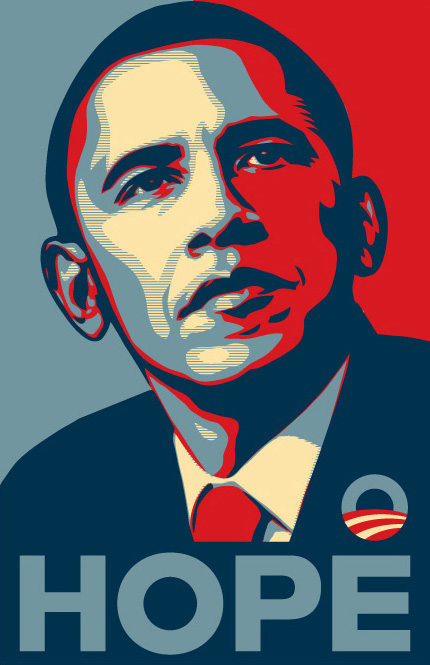
Thank you PRESIDENT Obama


Today was a historic day for the United States. Not only because we had a peaceful transition of the most powerful office in the world, nor because an African-American man took the mantle of that office (although both of those events play larger than what I am about to write about). Today PRESIDENT Obama acknowledged non-believers! I was already sitting up straight and proud as he took the oath of office (even with his little flub), but when he actually mentioned non-believers in his inaugural address, I finally felt as if I may be part of America, as opposed to sitting on the outskirts fighting a battle against bigotry, hatred, and small-mindedness. Like most of America, I feel incredible pride and hope for the future, albeit for different reasons than most Americans.

In a country where it would be easier to get elected to office as a felon than an atheist, it's nice to get some recognition from Citizen #1. We can only hope that this will lead to a more civil discourse on the secular nature of the Constitution, as well as understanding that Freedom OF religion requires a specific type of Freedom FROM religion. Lastly, maybe there will be more of a focus on SCIENCE as opposed to childish superstitions. Maybe I am hoping for too much?

Anyway, I was glad to hear even a slight acknowledgment. Again, thank you PRESIDENT Obama.

11 January 2009

2009 - The International Year of Astronomy


Okay, so I may be like a couple of weeks late in actually getting this post up, but I blame my preparing to deploy to Qatar on that... Anyway, I just wanted to make sure that those few folks that come here are also aware of what 2009 is all about. I am personally a huge fan of astronomy, so I feel that I MUST publicize this as well. Read on to find out more about it, and if you have a blog or some other type of publication, there is info for you here as well.

The International Year of Astronomy 2009 (IYA2009) celebrates the first astronomical use of the telescope by Galileo - a momentous event that initiated 400 years of astronomical discoveries and triggered a scientific revolution which profoundly affected our worldview. Now telescopes on the ground and in space explore the Universe, 24 hours a day, across all wavelengths of light. The President of the International Astronomical Union (IAU) Catherine Cesarsky says: "The International Year of Astronomy 2009 gives all nations a chance to participate in this ongoing exciting scientific and technological revolution."

The IYA2009 will highlight global cooperation for peaceful purposes - the search for our cosmic origin and our common heritage which connect all citizens of planet Earth. For several millennia, astronomers have worked together across all boundaries including geographic, gender, age, culture and race, in line with the principles of the UN Charter. In that sense, astronomy is a classic example of how science can contribute towards furthering international cooperation.

At the IAU General Assembly on 23 July 2003 in Sydney (Australia), the IAU unanimously approved a resolution in favour of the proclamation of 2009 as the International Year of Astronomy. Based on Italy's initiative, UNESCO's General Conference at its 33rd session recommended that the UN General Assembly adopt a resolution to declare 2009 the International Year of Astronomy. On 20 December 2007 the International Year of Astronomy 2009 was proclaimed by the United Nations 62nd General Assembly. The UN has designated the United Nations Educational, Scientific and Cultural Organization (UNESCO) as the lead agency for the IYA2009. The IAU will function as the facilitating body for IYA2009.

The IYA2009 is, first and foremost, an activity for the citizens of planet Earth. It aims to convey the excitement of personal discovery, the pleasure of sharing fundamental knowledge about the Universe and our place in it, and the merits of the scientific method. Astronomy is an invaluable source of inspiration for humankind throughout all nations. So far 99 nations and 14 organisations have signed up to participate in the IYA2009 ‚ an unprecedented network of committed communicators and educators in astronomy.

For more information on the International Year of Astronomy 2009 please visit the website at http://www.astronomy2009.org/


# # #

Notes for editors

The vision of the IYA2009 is to help the citizens of the world rediscover their place in the Universe through the day and night time sky ‚ and thereby engage a personal sense of wonder and discovery. All humans should realize the impact of astronomy and basic sciences on our daily lives, and understand better how scientific knowledge can contribute to a more equitable and peaceful society.

The aim of the IYA2009 is to stimulate worldwide interest, especially among young people, in astronomy and science under the central theme "The Universe, Yours to Discover". IYA2009 events and activities will promote a greater appreciation of the inspirational aspects of astronomy that embody an invaluable shared resource for all nations.

The IYA2009 activities will take place at the global and regional levels, and especially at the national and local levels. National Nodes in each country have been formed to prepare activities for 2009. These Nodes establish collaborations between professional and amateur astronomers, science centres, educators and science communicators in preparing activities for 2009.

The IAU is the international astronomical organisation that brings together almost 10,000 distinguished astronomers from all nations of the world. Its mission is to promote and safeguard the science of astronomy in all its aspects through international cooperation. The IAU also serves as the internationally recognized authority for assigning designations to celestial bodies and surface features on them. Founded in 1919, the IAU is the world's largest professional body for astronomers.

Additional information

IYA2009 website: www.astronomy2009.org

IYA2009 Opening Events: www.astronomy2009.org/events

Opening Ceremony Media accreditation: www.astronomy2009.org/opening

UNESCO IYA2009 website: www.unesco.org/iya2009

Opening Ceremony website: http://www.astronomy2009.org/opening

Dawn of IYA2009 (Solar Physics Group) website: www.solarastronomy2009.org

Cosmic Diary website (active 1 January 2009): www.cosmicdiary.org

365 Days of Astronomy: http://365daysofastronomy.org

100 Hours of Astronomy: www.100hoursofastronomy.org

From Earth To The Universe: www.fromearthtotheuniverse.org

Dark Skies Awareness: www.darkskiesawareness.org

The World at Night: www.twanight.org

International Astronomical Union website: www.iau.org

IYA2009 welcome video: www.astronomy2009.org/resources/multimedia/videos/

United States

Single Point of Contact

Doug Isbell


United States

Phone +1 520 991 0380
E-maildougisbell@hotmail.com
Websitehttp://www.astronomy2009.us/


Highlights

US IYA2009 opening eventLong Beach, CA
10 January 2009

NASA Great Observatories image release at science/nature centres and planetaria
14 - 28 February 2009
http://hubblesource.stsci.edu/events/iya/

Opening of Galileo exhibit at the Franklin Institute, Philadelphia, PA
2 April 2009
http://www2.fi.edu/

28 December 2008

NOT a christian Nation, just a Nation of christians

I have been getting into numerous arguments with the local theitards about the nature of the US Government. Sadly they keep bringing up the whole christian Nation lie again and again. It's as if they feel that speaking a lie often enough will somehow make it true. The circles they run in making sure that the First Amendment only apply to them, and no one else are disturbing to say the least...

As such, I present to you an essay from Jim Walker. I can only hope that eventually we will have no need for this essay, and can agree that the government of the United States is secular (notice I didn't say atheist either!).

A few Christian fundamentalists attempt to convince us to return to the Christianity of early America, yet according to the historian, Robert T. Handy, "No more than 10 percent-- probably less-- of Americans in 1800 were members of congregations."

The Founding Fathers, also, rarely practiced Christian orthodoxy. Although they supported the free exercise of any religion, they understood the dangers of religion. Most of them believed in deism and attended Freemasonry lodges. According to John J. Robinson, "Freemasonry had been a powerful force for religious freedom." Freemasons took seriously the principle that men should worship according to their own conscience. Masonry welcomed anyone from any religion or non-religion, as long as they believed in a Supreme Being. Washington, Franklin, Hancock, Hamilton, Lafayette, and many others accepted Freemasonry.

Treaty of Tripoli

The Constitution reflects our founders views of a secular government, protecting the freedom of any belief or unbelief. The historian, Robert Middlekauff, observed, "the idea that the Constitution expressed a moral view seems absurd. There were no genuine evangelicals in the Convention, and there were no heated declarations of Christian piety."

George Washington

Much of the myth of Washington's alleged Christianity came from Mason Weems influential book, "Life of Washington." The story of the cherry tree comes from this book and it has no historical basis. Weems, a Christian minister portrayed Washington as a devout Christian, yet Washington's own diaries show that he rarely attended Church.

Washington revealed almost nothing to indicate his spiritual frame of mind, hardly a mark of a devout Christian. In his thousands of letters, the name of Jesus Christ never appears. He rarely spoke about his religion, but his Freemasonry experience points to a belief in deism. Washington's initiation occurred at the Fredericksburg Lodge on 4 November 1752, later becoming a Master mason in 1799, and remained a freemason until he died.

To the United Baptist Churches in Virginia in May, 1789, Washington said that every man "ought to be protected in worshipping the Deity according to the dictates of his own conscience."

After Washington's death, Dr. Abercrombie, a friend of his, replied to a Dr. Wilson, who had interrogated him about Washington's religion replied, "Sir, Washington was a Deist."

Thomas Jefferson

Even most Christians do not consider Jefferson a Christian. In many of his letters, he denounced the superstitions of Christianity. He did not believe in spiritual souls, angels or godly miracles. Although Jefferson did admire the morality of Jesus, Jefferson did not think him divine, nor did he believe in the Trinity or the miracles of Jesus. In a letter to Peter Carr, 10 August 1787, he wrote, "Question with boldness even the existence of a god."

Jefferson believed in materialism, reason, and science. He never admitted to any religion but his own. In a letter to Ezra Stiles Ely, 25 June 1819, he wrote, "You say you are a Calvinist. I am not. I am of a sect by myself, as far as I know."

John Adams

John Adams John Adams

Adams, a Unitarian, flatly denied the doctrine of eternal damnation. In a letter to Thomas Jefferson, he wrote:

"I almost shudder at the thought of alluding to the most fatal example of the abuses of grief which the history of mankind has preserved -- the Cross. Consider what calamities that engine of grief has produced!"

In his letter to Samuel Miller, 8 July 1820, Adams admitted his unbelief of Protestant Calvinism: "I must acknowledge that I cannot class myself under that denomination."

In his, "A Defence of the Constitutions of Government of the United States of America" [1787-1788], John Adams wrote:

"The United States of America have exhibited, perhaps, the first example of governments erected on the simple principles of nature; and if men are now sufficiently enlightened to disabuse themselves of artifice, imposture, hypocrisy, and superstition, they will consider this event as an era in their history. Although the detail of the formation of the American governments is at present little known or regarded either in Europe or in America, it may hereafter become an object of curiosity. It will never be pretended that any persons employed in that service had interviews with the gods, or were in any degree under the influence of Heaven, more than those at work upon ships or houses, or laboring in merchandise or agriculture; it will forever be acknowledged that these governments were contrived merely by the use of reason and the senses.

". . . Thirteen governments [of the original states] thus founded on the natural authority of the people alone, without a pretence of miracle or mystery, and which are destined to spread over the northern part of that whole quarter of the globe, are a great point gained in favor of the rights of mankind."

James Madison

Called the father of the Constitution, Madison had no conventional sense of Christianity. In 1785, Madison wrote in his Memorial and Remonstrance against Religious Assessments:

"During almost fifteen centuries has the legal establishment of Christianity been on trial. What have been its fruits? More or less in all places, pride and indolence in the Clergy, ignorance and servility in the laity; in both, superstition, bigotry and persecution."

"What influence, in fact, have ecclesiastical establishments had on society? In some instances they have been seen to erect a spiritual tyranny on the ruins of the civil authority; on many instances they have been seen upholding the thrones of political tyranny; in no instance have they been the guardians of the liberties of the people. Rulers who wish to subvert the public liberty may have found an established clergy convenient auxiliaries. A just government, instituted to secure and perpetuate it, needs them not."

Benjamin Franklin

Although Franklin received religious training, his nature forced him to rebel against the irrational tenets of his parents Christianity. His Autobiography revels his skepticism, "My parents had given me betimes religions impressions, and I received from my infancy a pious education in the principles of Calvinism. But scarcely was I arrived at fifteen years of age, when, after having doubted in turn of different tenets, according as I found them combated in the different books that I read, I began to doubt of Revelation itself.

". . . Some books against Deism fell into my hands. . . It happened that they wrought an effect on my quite contrary to what was intended by them; for the arguments of the Deists, which were quoted to be refuted, appeared to me much stronger than the refutations; in short, I soon became a through Deist."

In an essay on "Toleration," Franklin wrote:

"If we look back into history for the character of the present sects in Christianity, we shall find few that have not in their turns been persecutors, and complainers of persecution. The primitive Christians thought persecution extremely wrong in the Pagans, but practiced it on one another. The first Protestants of the Church of England blamed persecution in the Romish church, but practiced it upon the Puritans. These found it wrong in the Bishops, but fell into the same practice themselves both here [England] and in New England."

Dr. Priestley, an intimate friend of Franklin, wrote of him:

"It is much to be lamented that a man of Franklin's general good character and great influence should have been an unbeliever in Christianity, and also have done as much as he did to make others unbelievers" (Priestley's Autobiography)

Thomas Paine

This freethinker and author of several books, influenced more early Americans than any other writer. Although he held Deist beliefs, he wrote in his famous The Age of Reason:

"I do not believe in the creed professed by the Jewish church, by the Roman church, by the Greek church, by the Protestant church, nor by any church that I know of. My own mind is my church. "

"Of all the systems of religion that ever were invented, there is no more derogatory to the Almighty, more unedifiying to man, more repugnant to reason, and more contradictory to itself than this thing called Christianity. "

The U.S. Constitution

The most convincing evidence that our government did not ground itself upon Christianity comes from the very document that defines it-- the United States Constitution.

If indeed our Framers had aimed to found a Christian republic, it would seem highly unlikely that they would have forgotten to leave out their Christian intentions in the Supreme law of the land. In fact, nowhere in the Constitution do we have a single mention of Christianity, God, Jesus, or any Supreme Being. There occurs only two references to religion and they both use exclusionary wording. The 1st Amendment's says, "Congress shall make no law respecting an establishment of religion. . ." and in Article VI, Section 3, ". . . no religious test shall ever be required as a qualification to any office or public trust under the United States."

Thomas Jefferson interpreted the 1st Amendment in his famous letter to the Danbury Baptist Association in January 1, 1802:

"I contemplate with sovereign reverence that act of the whole American people which declared that their legislature should 'make no law respecting an establishment of religion, or prohibiting the free exercise thereof,' thus building a wall of separation between church and State."

Some Religious activists try to extricate the concept of separation between church and State by claiming that those words do not occur in the Constitution. Indeed they do not, but neither does it exactly say "freedom of religion," yet the First Amendment implies both.

As Thomas Jefferson wrote in his Autobiography, in reference to the Virginia Act for Religious Freedom:

"Where the preamble declares, that coercion is a departure from the plan of the holy author of our religion, an amendment was proposed by inserting "Jesus Christ," so that it would read "A departure from the plan of Jesus Christ, the holy author of our religion;" the insertion was rejected by the great majority, in proof that they meant to comprehend, within the mantle of its protection, the Jew and the Gentile, the Christian and Mohammedan, the Hindoo and Infidel of every denomination."

James Madison, perhaps the greatest supporter for separation of church and State, and whom many refer to as the father of the Constitution, also held similar views which he expressed in his letter to Edward Livingston, 10 July 1822:

"And I have no doubt that every new example will succeed, as every past one has done, in shewing that religion & Govt will both exist in greater purity, the less they are mixed together."

Today, if ever our government needed proof that the separation of church and State works to ensure the freedom of religion, one only need to look at the plethora of Churches, temples, and shrines that exist in the cities and towns throughout the United States. Only a secular government, divorced from religion could possibly allow such tolerant diversity.

The Declaration of Independence

Many Christians who think of America as founded upon Christianity usually present the Declaration as "proof." The reason appears obvious: the document mentions God. However, the God in the Declaration does not describe Christianity's God. It describes "the Laws of Nature and of Nature's God." This nature's view of God agrees with deist philosophy but any attempt to use the Declaration as a support for Christianity will fail for this reason alone.

Article XI from the Treaty of Tripoli Article XI from the Treaty of Tripoli

More significantly, the Declaration does not represent the law of the land as it came before the Constitution. The Declaration aimed at announcing their separation from Great Britain and listed the various grievances with the "thirteen united States of America." The grievances against Great Britain no longer hold, and we have more than thirteen states. Today, the Declaration represents an important historical document about rebellious intentions against Great Britain at a time before the formation of our independent government. Although the Declaration may have influential power, it may inspire the lofty thoughts of poets, and judges may mention it in their summations, it holds no legal power today. Our presidents, judges and policemen must take an oath to uphold the Constitution, but never to the Declaration of Independence.

Of course the Declaration depicts a great political document, as it aimed at a future government upheld by citizens instead of a religious monarchy. It observed that all men "are created equal" meaning that we all come inborn with the abilities of life, liberty and the pursuit of happiness. That "to secure these rights, governments are instituted among men." The Declaration says nothing about our rights secured by Christianity, nor does it imply anything about a Christian foundation.

Treaty of Tripoli

Unlike governments of the past, the American Fathers set up a government divorced from religion. The establishment of a secular government did not require a reflection to themselves about its origin; they knew this as an unspoken given. However, as the U.S. delved into international affairs, few foreign nations knew about the intentions of America. For this reason, an insight from at a little known but legal document written in the late 1700s explicitly reveals the secular nature of the United States to a foreign nation. Officially called the "Treaty of peace and friendship between the United States of America and the Bey and Subjects of Tripoli, of Barbary," most refer to it as simply the Treaty of Tripoli. In Article 11, it states:

Joel Barlow, U.S. Consul General of Algiers Joel Barlow, U.S. Consul General of Algiers
Copyright National Portait Gallery Smithsonian Institution/Art Resource NY

"As the Government of the United States of America is not in any sense founded on the Christian religion; as it has in itself no character of enmity against the laws, religion, or tranquillity, of Musselmen; and as the said States never have entered into any war or act of hostility against any Mehomitan nation, it is declared by the parties that no pretext arising from religious opinions shall ever produce an interruption of the harmony existing between the two countries."

The preliminary treaty began with a signing on 4 November, 1796 (the end of George Washington's last term as president). Joel Barlow, the American diplomat served as counsel to Algiers and held responsibility for the treaty negotiations. Barlow had once served under Washington as a chaplain in the revolutionary army. He became good friends with Paine, Jefferson, and read Enlightenment literature. Later he abandoned Christian orthodoxy for rationalism and became an advocate of secular government. Barlow, along with his associate, Captain Richard O'Brien, et al, translated and modified the Arabic version of the treaty into English. From this came the added Amendment 11. Barlow forwarded the treaty to U.S. legislators for approval in 1797. Timothy Pickering, the secretary of state, endorsed it and John Adams concurred (now during his presidency), sending the document on to the Senate. The Senate approved the treaty on June 7, 1797, and officially ratified by the Senate with John Adams signature on 10 June, 1797. All during this multi-review process, the wording of Article 11 never raised the slightest concern. The treaty even became public through its publication in The Philadelphia Gazette on 17 June 1797.

So here we have a clear admission by the United States that our government did not found itself upon Christianity. Unlike the Declaration of Independence, this treaty represented U.S. law as all treaties do according to the Constitution (see Article VI, Sect. 2).

Although the Christian exclusionary wording in the Treaty of Tripoli only lasted for eight years and no longer has legal status, it clearly represented the feelings of our Founding Fathers at the beginning of the U.S. government.

Common Law

Signers of the Treaty of Tripoli Signers of the Treaty of Tripoli

According to the Constitution's 7th Amendment: "In suits at common law. . . the right of trial by jury shall be preserved; and no fact, tried by a jury, shall be otherwise re-examined in any court of the United States than according to the rules of the common law."

Here, many Christians believe that common law came from Christian foundations and therefore the Constitution derives from it. They use various quotes from Supreme Court Justices proclaiming that Christianity came as part of the laws of England, and therefore from its common law heritage.

But one of our principle Founding Fathers, Thomas Jefferson, elaborated about the history of common law in his letter to Thomas Cooper on February 10, 1814:

"For we know that the common law is that system of law which was introduced by the Saxons on their settlement in England, and altered from time to time by proper legislative authority from that time to the date of Magna Charta, which terminates the period of the common law. . . This settlement took place about the middle of the fifth century. But Christianity was not introduced till the seventh century; the conversion of the first christian king of the Heptarchy having taken place about the year 598, and that of the last about 686. Here then, was a space of two hundred years, during which the common law was in existence, and Christianity no part of it.

". . . if any one chooses to build a doctrine on any law of that period, supposed to have been lost, it is incumbent on him to prove it to have existed, and what were its contents. These were so far alterations of the common law, and became themselves a part of it. But none of these adopt Christianity as a part of the common law. If, therefore, from the settlement of the Saxons to the introduction of Christianity among them, that system of religion could not be a part of the common law, because they were not yet Christians, and if, having their laws from that period to the close of the common law, we are all able to find among them no such act of adoption, we may safely affirm (though contradicted by all the judges and writers on earth) that Christianity neither is, nor ever was a part of the common law."

In the same letter, Jefferson examined how the error spread about Christianity and common law. Jefferson realized that a misinterpretation had occurred with a Latin term by Prisot, "*ancien scripture*," in reference to common law history. The term meant "ancient scripture" but people had incorrectly interpreted it to mean "Holy Scripture," thus spreading the myth that common law came from the Bible. Jefferson writes:

"And Blackstone repeats, in the words of Sir Matthew Hale, that 'Christianity is part of the laws of England,' citing Ventris and Strange ubi surpa. 4. Blackst. 59. Lord Mansfield qualifies it a little by saying that 'The essential principles of revealed religion are part of the common law." In the case of the Chamberlain of London v. Evans, 1767. But he cites no authority, and leaves us at our peril to find out what, in the opinion of the judge, and according to the measure of his foot or his faith, are those essential principles of revealed religion obligatory on us as a part of the common law."

Thus we find this string of authorities, when examined to the beginning, all hanging on the same hook, a perverted expression of Priscot's, or on one another, or nobody."

The Encyclopedia Britannica, also describes the Saxon origin and adds: "The nature of the new common law was at first much influenced by the principles of Roman law, but later it developed more and more along independent lines." Also prominent among the characteristics that derived out of common law include the institution of the jury, and the right to speedy trial.

Christian Sources

Virtually all the evidence that attempts to connect a foundation of Christianity upon the government rests mainly on quotes and opinions from a few of the colonial statesmen who had professed a belief in Christianity. Sometimes the quotes come from their youth before their introduction to Enlightenment ideas or simply from personal beliefs. But statements of beliefs, by themselves, say nothing about Christianity as the source of the U.S. government.

There did occur, however, some who wished a connection between church and State. Patrick Henry, for example, proposed a tax to help sustain "some form of Christian worship" for the state of Virginia. But Jefferson and other statesmen did not agree. In 1779, Jefferson introduced a bill for the Statute for Religious Freedom which became Virginia law. Jefferson designed this law to completely separate religion from government. None of Henry's Christian views ever got introduced into Virginia's or U.S. Government law.

Unfortunately, later developments in our government have clouded early history. The original Pledge of Allegiance, authored by Francis Bellamy in 1892 did not contain the words "under God." Not until June 1954 did those words appear in the Allegiance. The United States currency never had "In God We Trust" printed on money until after the Civil War. Many Christians who visit historical monuments and see the word "God" inscribed in stone, automatically impart their own personal God of Christianity, without understanding the Framers Deist context.

In the Supreme Court's 1892 Holy Trinity Church vs. United States, Justice David Brewer wrote that "this is a Christian nation." Many Christians use this as evidence. However, Brewer wrote this in dicta, as a personal opinion only and does not serve as a legal pronouncement. Later Brewer felt obliged to explain himself: "But in what sense can [the United States] be called a Christian nation? Not in the sense that Christianity is the established religion or the people are compelled in any manner to support it. On the contrary, the Constitution specifically provides that 'Congress shall make no law respecting an establishment of religion or prohibiting the free exercise thereof.' Neither is it Christian in the sense that all its citizens are either in fact or in name Christians. On the contrary, all religions have free scope within its borders. Numbers of our people profess other religions, and many reject all."

Conclusion

The Framers derived an independent government out of Enlightenment thinking against the grievances caused by Great Britain. Our Founders paid little heed to political beliefs about Christianity. The 1st Amendment stands as the bulkhead against an establishment of religion and at the same time insures the free expression of any belief. The Treaty of Tripoli, an instrument of the Constitution, clearly stated our non-Christian foundation. We inherited common law from Great Britain which derived from pre-Christian Saxons rather than from Biblical scripture.

Today we have powerful Christian organizations who work to spread historical myths about early America and attempt to bring a Christian theocracy to the government. If this ever happens, then indeed, we will have ignored the lessons from history. Fortunately, most liberal Christians today agree with the principles of separation of church and State, just as they did in early America.

"They all attributed the peaceful dominion of religion in their country mainly to the separation of church and state. I do not hesitate to affirm that during my stay in America I did not meet a single individual, of the clergy or the laity, who was not of the same opinion on this point"

-Alexis de Tocqueville, Democracy in America, 1835


Bibliography

Borden, Morton, "Jews, Turks, and Infidels," The University of North Carolina Press, 1984

Boston, Robert, "Why the Religious Right is Wrong About Separation of Church & State, "Prometheus Books, 1993

Boston, F. Andrews, et al, "The Writings of George Washington," (12 Vols.), Charleston, S.C., 1833-37

Fitzpatrick, John C., ed., "The Diaries of George Washington, 1748-1799," Houghton Mifflin Company: Published for the Mount Vernon Ladies Association of the Union, 1925

Gay, Kathlyn, "Church and State,"The Millbrook Press," 1992

Handy, Robert, T., "A History of the Churches in U.S. and Canada," New York: Oxford University Press, 1977

Hayes, Judith, "All those Christian Presidents," [The American Rationalist, March/April 1997]

Kock, Adrienne, ed., "The American Enlightenment: The Shaping of the American Experiment and a Free Society," New York: George Braziller, 1965

Mapp, Jr, Alf J., "Thomas Jefferson," Madison Books, 1987

Middlekauff, Robert, "The Glorious Cause," Oxford University Press, 1982

Miller, Hunter, ed., "Treaties and other International Acts of the United States of America," Vol. 2, Documents 1-40: 1776-1818, United States Government Printing Office, Washington: 1931

Peterson, Merrill D., "Thomas Jefferson Writings," The Library of America, 1984

Remsburg, John E., "Six Historic Americans," The Truth Seeker Company, New York

Robinson, John J., "Born in Blood," M. Evans & Company, New York, 1989

Roche, O.I.A., ed, "The Jefferson Bible: with the Annotated Commentaries on Religion of Thomas Jefferson," Clarkson N. Potter, Inc., 1964

Seldes, George, ed., "The Great Quotations," Pocket Books, New York, 1967

Sweet, William W., "Revivalism in America, its origin, growth and decline," C. Scribner's Sons, New York, 1944

Woodress, James, "A Yankee's Odyssey, the Life of Joel Barlow," J. P. Lippincott Co., 1958

Encyclopedia sources:

Common law: Encyclopedia Britannica, Vol. 6, "William Benton, Publisher, 1969

Declaration of Independence: MicroSoft Encarta 1996 Encyclopedia, MicroSoft Corp., Funk & Wagnalls Corporation.

In God We Trust: MicroSoft Encarta 1996 Encyclopedia, MicroSoft Corp., Funk & Wagnalls Corporation.

Pledge of Allegiance: Academic American Encyclopedia, Vol. 15, Grolier Incorporated, Danbury, Conn., 1988

Special thanks to Ed Buckner, Robert Boston, Selena Brewington and Lion G. Miles, for help in providing me with source materials.