



This is the video that introduced me to QualiaSoup. I really would love to have people view this video again and again, and make critical thinking a true New Year resolution.
31 December 2011


30 December 2011
Skewed views of science
This video addresses one of my biggest complaints when I get into a "debate" with someone. Not only do I have to debate the numerous factual errors they carry around, but I also have to correct some sort of gross caricature of science they posses. Hopefully this video will help people understand a bit more about their own ignorance and biases.
29 December 2011
The Faith Cake
QuailiaSoup is a fantastic YouTube producer. He has a series of videos that everyone should really watch. I am going to post a series of his videos over the next few days/weeks. Again, I encourage you to watch them, and see how they really ought to be applied in society in general. Don't be offended or afraid if they strike too close to home for your comfort. That is what they are supposed to do. As a species, we can't move forward without at least challenging those things we have always thought were a revealed truth to us.
28 December 2011
Science is Cool (and empty?)
Dr. Brian Cox is a scientist (and a musician, TV personality, and all around cool guy). One of the things that I like the most about him is that he is so enthusiastic about science. In this video, he does a demonstration that shows not only how we know that an atom consists of mainly nothing, but I think he touches on a great idea of science. That is, before we knew that atoms were mostly empty space, many imagined them to be like solid balls or in other ways much more material than we now know them to be.
That's probably the greatest strength of science. That it will actually accept evidence that is contrary to conventional wisdom, as long as that evidence is repeatable, reliable, and presented in a manner that adheres to reality. Anyway, enjoy this video, and even if you didn't learn anything particularly new, understand that the process of finding these things out is amazing in itself.
That's probably the greatest strength of science. That it will actually accept evidence that is contrary to conventional wisdom, as long as that evidence is repeatable, reliable, and presented in a manner that adheres to reality. Anyway, enjoy this video, and even if you didn't learn anything particularly new, understand that the process of finding these things out is amazing in itself.
24 December 2011
Free Thought Blogs: Atheistic christmas.
To tell you the truth, this is more about an opportunity to get some time off from work where everyone else is too (i.e. not much is happening so I can do so with a clear conscience), and the opportunity to eat some good food and just hang out with the ones I love. That's it. So I really forgot that this is generally a "big deal" to a lot of Americans. Maybe because I have moved up here to a much more secular area of our country. I am not getting accosted with overt preaching, or the Faux Noise nonsense of some war (in their minds) against this holiday season. It's actually been one of the more enjoyable for me. (By the way, I favour the European tradition of doing gifts and stuff on christmas eve. We have already eaten good food, had good drink, and done our celebration. I get to sleep in tomorrow. By the way, our traditional meal consists of lobster, smoked salmon, caviar, champagne, etc. You know, good stuff I didn't have last month.)
Of course, as someone who doesn't buy into any of the legends surrounding this holiday, I forget that some folks get their panties in a bunch about it for one reason or another. So Edwin Kagin put things in a bit of a perspective for me when I read this post. I think I most just shook my head ruefully as I read it.
Of course, as someone who doesn't buy into any of the legends surrounding this holiday, I forget that some folks get their panties in a bunch about it for one reason or another. So Edwin Kagin put things in a bit of a perspective for me when I read this post. I think I most just shook my head ruefully as I read it.
It is Christmas Eve, and I have almost lived through this year’s annual greatest of holidays. At midnight, Christmas will begin, and twenty-four hours later it will end. It will be over! But not yet. At this writing, the world is shutting down in anticipation. The 24 Hour Kroger closed at 6:00 pm. Gas stations are closing. People are smiling. Even NRP is playing Xmas music.CLICK HERE TO READ THE REST OF THE POST.
Lots of people are in church. Children are nestling to greater or lesser degrees of snugness in their beds awaiting, or fearing, the coming of Santa, an anagram for Satan. Lots of people are getting drunk, and lots are getting laid.
Santa Clause is coming to town. Not a very good modern role model actually. Overweight; labor laws scoffer; animal rights ignorer; and—believe it with horror—a smoker!
Some folks will die in car crashes from negligence and some will die by their own hands from, inter alia, pills, or pistols, unable to deal with what they experience as the depression and loneliness of the day. And it will be observed how awful it was for this to happen on Christmas. How dare they stain the wonder and magic of Christmas with their blood?
After the ripping of the packages, some fine meals will be consumed and much booze will be ingested.
09 December 2011
Get Up Early Tomorrow!
You really need to get up early tomorrow morning. I know, it's a Saturday, and you want to sleep in, but you'll have a chance to see something pretty cool. Basically, there will be a lunar eclipse that may coincide with sunrise. Hopefully the weather in your area cooperates.
I know that generally a lunar eclipse is pretty ho-hum, but this particular confluence of celestial movements actually will be much more noteworthy for many of us. Dr. Phil Plait (The Bad Astronomer) explains more:
I know that generally a lunar eclipse is pretty ho-hum, but this particular confluence of celestial movements actually will be much more noteworthy for many of us. Dr. Phil Plait (The Bad Astronomer) explains more:
CLICK HERE TO READ THE REST OF HIS EXPLANATION!Watch The Lunar Eclipse Saturday
Tomorrow (Saturday December 10) the Moon will pass into the Earth’s shadow, causing it to plunge into ruddy darkness, an event called a total lunar eclipse. These happen roughly twice a year somewhere on Earth, but this is the last one visible in North America for more than two years, so even though it’s in the morning it might be worth a look for you.
You can get all the info you need on watching the eclipse from my pal Alan Boyle over at the Cosmic Log, including timing, locations, and where to watch live online, too. NASA has a page with more detailed information as well. This one favors US folks farther west; the Moon will have set when the eclipse really starts for East Coast folks.
But the fun begins when the Moon starts to enter the deepest part of the Earth’s shadow at 12:45 UT (04:45 Pacific US time), and the last bit passes into shadow at 14:06 UT (06:06 Pacific). Deepest eclipse is about 25 minutes after that. Interestingly, for people in the western US, that’s around the same time as sunrise. For me, the Sun rises at 07:12 (Mountain time) Saturday, and the Moon sets at 07:14 — when it’s still partially eclipsed! Unfortunately, the mountains to the west will block my view of the setting Moon.
But for those of you with a clear horizon to the east and west, you may get an extraordinary opportunity to very briefly see the Sun and eclipsed Moon at the same time! Normally this isn’t possible; by definition the Moon and Sun have to be directly opposite each in the sky to get an eclipse at all.
But due to a quirk of geometry and atmospheric physics, it is possible. The Earth’s air acts like a lens, bending the light from objects near the horizon. Because of this effect — I give a full explanation here — you can actually see the Moon for a minute or two after it has physically set; its light is bent "around the corner", so to speak, so both it and the Sun will be over the horizon for a short amount of time. You can face west to see the setting eclipsed Moon, then turn around and see the rising Sun in the East!
03 December 2011
Technical Difficulties (And the war on christmyth)
Well, it seems that I have been rather quiet this past month and haven't said much of anything. Well, actually, I did put a couple of posts together between work, studying for my PMP, and in general just doing stuff. However, for some reason, they all got saved as drafts and never actually published. Oops... And since I actually put them together ahead of time, I wasn't really monitoring them. My bad!
Anyway, I will get them up here as soon as I can. In the meantime, how about a rundown of some of the traditional December posts that will re-affirm the so called "war on christmas"? I must say though, since having moved up here to New Hampshire, I hear a lot less gnashing of teeth and rending of garments on this subject than I did when I lived down south. I think that stems a lot more from theists (and New Englanders in general) up here actually understanding that it's a private thing, and dragging everyone else into it whether they want to or not is frowned upon. Now if only the southern theitards would understand that....
Even less evidence for jebus
Merry christMyth
List of other deities also not born on the 25th
christmas as engineered hate
An atheist's guide to xmas
Santa vs. god
Remember the 2010 war on christmas
Report from the front line of 2010 war on xmas.
Anyway, I will get them up here as soon as I can. In the meantime, how about a rundown of some of the traditional December posts that will re-affirm the so called "war on christmas"? I must say though, since having moved up here to New Hampshire, I hear a lot less gnashing of teeth and rending of garments on this subject than I did when I lived down south. I think that stems a lot more from theists (and New Englanders in general) up here actually understanding that it's a private thing, and dragging everyone else into it whether they want to or not is frowned upon. Now if only the southern theitards would understand that....
Even less evidence for jebus
Merry christMyth
List of other deities also not born on the 25th
christmas as engineered hate
An atheist's guide to xmas
Santa vs. god
Remember the 2010 war on christmas
Report from the front line of 2010 war on xmas.
27 November 2011
Paraprosdokians
What a cool word! Paraprosdokians! So, what the hell is it? A paraprosdokian is a figure of speech in which the latter part of a sentence or phrase is surprising or unexpected in a way that causes the reader or listener to reframe or reinterpret the first part. It is frequently used for humorous or dramatic effect, sometimes producing an anticlimax.
Here is a small list that you may be familiar with. Why not add your own:
1. Do not argue with an idiot. He will drag you down to his level and beat you with experience.
2. Going to church doesn't make you a Christian any more than standing in a garage makes you a car.
3. The last thing I want to do is hurt you. But it's still on the list.
4. If I agreed with you we'd both be wrong.
5. We never really grow up, we only learn how to act in public.
6. War does not determine who is right - only who is left.
7. Knowledge is knowing a tomato is a fruit; wisdom is not putting it in a fruit salad.
8. Evening news is where they begin with 'Good evening', and then proceed to tell you why it isn't.
9. A bus station is where a bus stops. A train station is where a train stops. On my desk, I have a work station.
10. How is it one careless match can start a forest fire, but it takes a whole box to start a campfire?
11. Dolphins are so smart that within a few weeks of captivity, they can train people to stand on the very edge of the pool and throw them fish.
12. I thought I wanted a career, turns out I just wanted pay checks.
13. Whenever I fill out an application, in the part that says "In an emergency, notify:" I put "Doctor".
14. I didn't say it was your fault, I said I was blaming you.
15. Behind every successful man is his woman. Behind the fall of a successful man is usually another woman.
16. You do not need a parachute to skydive. You only need a parachute to skydive twice.
17. The voices in my head may not be real, but they have some good ideas!
18. Hospitality: Making your guests feel like they're at home, even if you wish they were.
19. I discovered I scream the same way whether I'm about to be devoured by a great white shark or if a piece of seaweed touches my foot.
20. There's a fine line between cuddling and holding someone down so they can't get away.
21. I always take life with a grain of salt, plus a slice of lemon, and a shot of tequila.
22. When tempted to fight fire with fire, remember that the Fire Department usually uses water.
23. You're never too old to learn something stupid.
24. To be sure of hitting the target, shoot first and call whatever you hit the target.
Here is a small list that you may be familiar with. Why not add your own:
1. Do not argue with an idiot. He will drag you down to his level and beat you with experience.
2. Going to church doesn't make you a Christian any more than standing in a garage makes you a car.
3. The last thing I want to do is hurt you. But it's still on the list.
4. If I agreed with you we'd both be wrong.
5. We never really grow up, we only learn how to act in public.
6. War does not determine who is right - only who is left.
7. Knowledge is knowing a tomato is a fruit; wisdom is not putting it in a fruit salad.
8. Evening news is where they begin with 'Good evening', and then proceed to tell you why it isn't.
9. A bus station is where a bus stops. A train station is where a train stops. On my desk, I have a work station.
10. How is it one careless match can start a forest fire, but it takes a whole box to start a campfire?
11. Dolphins are so smart that within a few weeks of captivity, they can train people to stand on the very edge of the pool and throw them fish.
12. I thought I wanted a career, turns out I just wanted pay checks.
13. Whenever I fill out an application, in the part that says "In an emergency, notify:" I put "Doctor".
14. I didn't say it was your fault, I said I was blaming you.
15. Behind every successful man is his woman. Behind the fall of a successful man is usually another woman.
16. You do not need a parachute to skydive. You only need a parachute to skydive twice.
17. The voices in my head may not be real, but they have some good ideas!
18. Hospitality: Making your guests feel like they're at home, even if you wish they were.
19. I discovered I scream the same way whether I'm about to be devoured by a great white shark or if a piece of seaweed touches my foot.
20. There's a fine line between cuddling and holding someone down so they can't get away.
21. I always take life with a grain of salt, plus a slice of lemon, and a shot of tequila.
22. When tempted to fight fire with fire, remember that the Fire Department usually uses water.
23. You're never too old to learn something stupid.
24. To be sure of hitting the target, shoot first and call whatever you hit the target.
22 November 2011
There ARE some things worse than being ignorant
I am a huge supporter of education. I have always said that ignorance is the equalizer of all unsuccessful and small minded morons out there. And one good source of general education is the news. That is, if it's actual news! It appears that Fox News viewers are less informed than people who don't watch any news, according to a new poll from Fairleigh Dickinson University. The poll surveyed New Jersey residents about the uprisings in Egypt and the Middle East, and where they get their news sources. The study, which controlled for demographic factors like education and partisanship, has shown that being a Faux Noise viewer will actually make you more ignorant of the world around you... Either that, or you are just gullible enough to swallow the outright lies of that fake news outlet.
Interestingly, speaking of fake news outlets, people who watch The Daily Show actually scored at the top of the survey in factual accuracy! I am starting to think that perhaps Faux Noise is some sort of massive art project to see just how big a pile of bullshit people will swallow...
Interestingly, speaking of fake news outlets, people who watch The Daily Show actually scored at the top of the survey in factual accuracy! I am starting to think that perhaps Faux Noise is some sort of massive art project to see just how big a pile of bullshit people will swallow...
16 November 2011
The political season of wackiness
A while back the T.E.A. party started, and the rank and file were an amazingly representative slice of the US. Many of the members of that party even proudly proclaimed that they did indeed represent Americans. And perhaps they did. However, it is now another election season, and let's look at the teabaggers now? In 2008 there started to be some ugly groundswells in that movement that were basically ignored. Now, I don't think you can ignore it. Instead of being representative, they have turned into the actual caricature that some started to make of them. Now they really are a bunch of redneck, theitard, racist, wackjobs... (and yes, I realize theitard and wackjob is redundant!) Not that this hasn't been mentioned before.
For a short but accurate take on “tea party” and religion, just see:
http://andrewsullivan.thedailybeast.com/2011/08/the-tea-party-as-a-christianist-force.html
And for both the far-right and religious aspects, just see:
http://digitaljournal.com/article/289821
Sullivan quoting the NYT:
“Next to being a Republican, the strongest predictor of being a Tea Party supporter today was a desire, back in 2006, to see religion play a prominent role in politics. And Tea Partiers continue to hold these views: they seek “deeply religious” elected officials, approve of religious leaders’ engaging in politics and want religion brought into political debates. The Tea Party’s generals may say their overriding concern is a smaller government, but not their rank and file, who are more concerned about putting God in government.”
But there’s no lack of details – data, facts, in fact, but also explanations, even hypotheses – that further support the characterization as both “far right” and “mired in a radical religious agenda”, of which these links are just smatterings:
http://www.npr.org/2010/11/22/131512631/culture-war-brewing-within-tea-party
http://colorado.tenthamendmentcenter.com/2010/12/the-fourth-tea-party/
http://www.alternet.org/teaparty/149572/new_study:_tea_partiers_three_times_more_likely_to_say_violence_is_warranted._exhibit_a:_glenn_beck
http://www.theatlantic.com/daily-dish/archive/2011/01/the-tea-party-more-anti-gay-than-all-seniors/177062/
http://www.theatlantic.com/daily-dish/archive/2011/01/the-tea-party-on-prohibition-lovin-it/177056/
http://www.alternet.org/economy/150097/tea_partiers_have_a_very_mixed-up_notion_of_what_the_american_revolution_was_about
http://www.csmonitor.com/USA/Politics/2011/0324/Planned-Parenthood-showdown-could-reveal-true-nature-of-tea-party
http://www.theatlantic.com/daily-dish/archive/2011/03/race-the-tea-party-and-conservatism/173650/
http://andrewsullivan.thedailybeast.com/2011/04/ygl.html
For a short but accurate take on “tea party” and religion, just see:
http://andrewsullivan.thedailybeast.com/2011/08/the-tea-party-as-a-christianist-force.html
And for both the far-right and religious aspects, just see:
http://digitaljournal.com/article/289821
Sullivan quoting the NYT:
“Next to being a Republican, the strongest predictor of being a Tea Party supporter today was a desire, back in 2006, to see religion play a prominent role in politics. And Tea Partiers continue to hold these views: they seek “deeply religious” elected officials, approve of religious leaders’ engaging in politics and want religion brought into political debates. The Tea Party’s generals may say their overriding concern is a smaller government, but not their rank and file, who are more concerned about putting God in government.”
But there’s no lack of details – data, facts, in fact, but also explanations, even hypotheses – that further support the characterization as both “far right” and “mired in a radical religious agenda”, of which these links are just smatterings:
http://www.npr.org/2010/11/22/131512631/culture-war-brewing-within-tea-party
http://colorado.tenthamendmentcenter.com/2010/12/the-fourth-tea-party/
http://www.alternet.org/teaparty/149572/new_study:_tea_partiers_three_times_more_likely_to_say_violence_is_warranted._exhibit_a:_glenn_beck
http://www.theatlantic.com/daily-dish/archive/2011/01/the-tea-party-more-anti-gay-than-all-seniors/177062/
http://www.theatlantic.com/daily-dish/archive/2011/01/the-tea-party-on-prohibition-lovin-it/177056/
http://www.alternet.org/economy/150097/tea_partiers_have_a_very_mixed-up_notion_of_what_the_american_revolution_was_about
http://www.csmonitor.com/USA/Politics/2011/0324/Planned-Parenthood-showdown-could-reveal-true-nature-of-tea-party
http://www.theatlantic.com/daily-dish/archive/2011/03/race-the-tea-party-and-conservatism/173650/
http://andrewsullivan.thedailybeast.com/2011/04/ygl.html
09 November 2011
On (what would have been) Carl Sagan's 77th Birthday
Today Dr. Phil Plait reminded me that today is the day that Carl Sagan would have turned 77. I really don't think that I could say anything better than Dr. Plait said it, nor even the way that Dr. Sagan would have said it. I think that Dr. Plait selected one of the best videos from the pile to choose from. Generally I hate autotune, but I was tempted to go with the Symphony of Science series, but I will stay with regular convention.
And I figure that I would close it out with a couple of quotes from Dr. Sagan that I think really sum up so many things so beautifully on top of the Pale Blue Dot video.
And I figure that I would close it out with a couple of quotes from Dr. Sagan that I think really sum up so many things so beautifully on top of the Pale Blue Dot video.
In science it often happens that scientists say, "You know that's a really good argument; my position is mistaken," and then they would actually change their minds and you never hear that old view from them again. They really do it. It doesn't happen as often as it should, because scientists are human and change is sometimes painful. But it happens every day. I cannot recall the last time something like that happened in politics or religion.
Who is more humble? The scientist who looks at the universe with an open mind and accepts whatever it has to teach us, or somebody who says everything in this book must be considered the literal truth and never mind the fallibility of all the human beings involved?
- Keynote address at CSICOP conference (1987)
I would love to believe that when I die I will live again, that some thinking, feeling, remembering part of me will continue. But much as I want to believe that, and despite the ancient and worldwide cultural traditions that assert an afterlife, I know of nothing to suggest that it is more than wishful thinking. The world is so exquisite with so much love and moral depth, that there is no reason to deceive ourselves with pretty stories for which there's little good evidence. Far better it seems to me, in our vulnerability, is to look death in the eye and to be grateful every day for the brief but magnificent opportunity that life provides.
- Interview with Charlie Rose (1996)
In some respects, science has far surpassed religion in delivering awe. How is it that hardly any major religion has looked at science and concluded, "This is better than we thought! The Universe is much bigger than our prophets said, grander, more subtle, more elegant. God must be even greater than we dreamed"? Instead they say, "No, no, no! My god is a little god, and I want him to stay that way."
- "In the Valley of the Shadow", Parade, 1996-03-10
- Pale Blue Dot, p. 50
03 November 2011
An Open Letter to the United States Congress
Direct copy paste with Todd W.'s permission:
Dear Members of Congress,
I recently learned that you passed, overwhelmingly, a resolution (PDF) reaffirming "In God We Trust" as the official motto of the United States. I am left to wonder, why?
Have you, unbeknown to the rest of the country, implemented legislation to help create jobs? Have you worked to improve health care? Cut down our debt? Eliminate waste?
How much time did you take away from important matters to not only vote on this, but to draft, read, refer to committee, approve and all the steps required to bring this to the full House?
Maybe I'm wrong to chastise you for wasting time on a resolution that has no power in law and accomplishes nothing to address the issues facing our nation. So let me bring up something else. When you were elected to office, you swore to uphold the Constitution. Part of that document, the supreme law of our land, is that Congress "shall make no law respecting an establishment of religion". Although the resolution is not a law, it would seem to me, as well as some of your colleagues who opposed this resolution, that the spirit of the resolution violates the principles of the First Amendment.
Beyond this, the text of the resolution makes several errors of fact.
Those who drafted this resolution have shown a disrespect for the Constitution they are sworn to uphold. Those who voted in favor of this resolution have shown a disrespect for the citizens they purport to represent. Only those who, through careful thought and the courage to stay true to their duty, voted against this resolution are deserving of our praise and approbation.
I place my trust in the people around me. I trust in scientists and doctors to advance our knowledge and improve our well being. I trust in my friends, family and acquaintances, that they will do their best to improve their lot and that of everyone around them. I trust, rightly or (as evidenced by this resolution and the constant bickering along party lines) wrongly, in lawmakers to properly and truly serve all of the people they represent, not only those who happen to be in the majority or who give the most dollars.
That is a trust that you have broken. You have broken faith with the people of these United States. For the actions of people decide the fate of our nation. It is "we the people" who move this country forward. We the people will raise the nation up or, through ideology and greed, bring it crashing down.
I implore you, as individuals, elected by the people, purporting to represent our interests, do what is right and rescind this resolution. And if not, then I call upon those whose minds are like mine, to replace everyone who voted in favor of this resolution with someone who places the good of the nation, rather than the good of religion, first.
Dear Members of Congress,
I recently learned that you passed, overwhelmingly, a resolution (PDF) reaffirming "In God We Trust" as the official motto of the United States. I am left to wonder, why?
Have you, unbeknown to the rest of the country, implemented legislation to help create jobs? Have you worked to improve health care? Cut down our debt? Eliminate waste?
How much time did you take away from important matters to not only vote on this, but to draft, read, refer to committee, approve and all the steps required to bring this to the full House?
Maybe I'm wrong to chastise you for wasting time on a resolution that has no power in law and accomplishes nothing to address the issues facing our nation. So let me bring up something else. When you were elected to office, you swore to uphold the Constitution. Part of that document, the supreme law of our land, is that Congress "shall make no law respecting an establishment of religion". Although the resolution is not a law, it would seem to me, as well as some of your colleagues who opposed this resolution, that the spirit of the resolution violates the principles of the First Amendment.
Beyond this, the text of the resolution makes several errors of fact.
Whereas the sentiment, "In God We Trust", has been an integral part of United States society since its foundingThis is not true. While many of the founders may have placed their trust in God, it was made quite clear in the writings of several of the founding fathers that this nation was a secular one. It should further be noted that it was not even the official motto of the United States until 1956.
Whereas in times of national challenge or tragedy, the people of the United States have turned to God as their source for sustenance, protection,wisdom, strength, and directionAlthough this may be true of a majority of the people, it is not true as a blanket sentiment. There are many individuals who have turned to multiple gods or to no god at all, but rather have looked to one another for comfort and solidarity.
Whereas John Adams said, "Statesmen may plan and speculate for Liberty, but it is Religion and Morality alone, which can establish the Principles upon which Freedom can securely stand."While he may have said these words, the writers and backers of this resolution ignore what else President Adams wrote in the Treaty of Tripoli:
As the Government of the United States of America is not, in any sense, founded on the Christian religionConcurrent Resolution 13 raises up one religion (or a class of religions) above all others. You have taken steps to exclude by sentiment those who do not believe in God, those who believe in multiple gods and those who have no belief in any deity of any sort. The language of the resolution makes it explicit that the intent of the resolution invokes religion, rather than a secular cause. Furthermore, wedding government and religion in such a manner sets a dangerous precedent. It is both bad politics and bad religion, for while Christianity is currently the dominant religion in this nation (in terms of number of practitioners), it may not always be so. Using the secular government of our nation for en explicitly religious reason such as this opens the door to further waste of time and resources, as well as the establishment of resolutions and language associated with religious matters in the future, to the detriment of all citizens of this country.
Those who drafted this resolution have shown a disrespect for the Constitution they are sworn to uphold. Those who voted in favor of this resolution have shown a disrespect for the citizens they purport to represent. Only those who, through careful thought and the courage to stay true to their duty, voted against this resolution are deserving of our praise and approbation.
I place my trust in the people around me. I trust in scientists and doctors to advance our knowledge and improve our well being. I trust in my friends, family and acquaintances, that they will do their best to improve their lot and that of everyone around them. I trust, rightly or (as evidenced by this resolution and the constant bickering along party lines) wrongly, in lawmakers to properly and truly serve all of the people they represent, not only those who happen to be in the majority or who give the most dollars.
That is a trust that you have broken. You have broken faith with the people of these United States. For the actions of people decide the fate of our nation. It is "we the people" who move this country forward. We the people will raise the nation up or, through ideology and greed, bring it crashing down.
I implore you, as individuals, elected by the people, purporting to represent our interests, do what is right and rescind this resolution. And if not, then I call upon those whose minds are like mine, to replace everyone who voted in favor of this resolution with someone who places the good of the nation, rather than the good of religion, first.
21 October 2011
100 Voices of Disbelief
I've mentioned a few times why I am atheist, and I've also tried to use quotes and other people's essays to help explain. Yet I still get the questions from people who just can't understand (or would that be unwilling to understand), how or why I just don't believe in god(s). Okay, maybe if I can't articulate it, maybe these people can? These are two videos that total about an hour that has 100 renowned academics speak about their disbelief. Hopefully you have heard of these folks, but even if you have not, they are giants in their fields. I really urge you to watch both videos, they are well worth your time.
Part II:
In case you are interested in who all these people are, Jerry Coyne of "Why Evolution is True" has a list of all the folks in the video, and has even highlighted the ones he thinks said it best. I think you should listen to both videos in their entirety.
Part II:
In case you are interested in who all these people are, Jerry Coyne of "Why Evolution is True" has a list of all the folks in the video, and has even highlighted the ones he thinks said it best. I think you should listen to both videos in their entirety.
19 October 2011
A Dynamic Random Quote Generator Sig
Over at the Rational Skepticism forums, a poster by the name of Jakov came up with a dynamic sig that puts some quotes onto forum profiles as an image. Then one of the other members, by the name or crank, of RatSkep updated it. You even have two separate styles to choose from. Just enclose the img code inside HTML or BBCode tags.
img=http://bit.ly/kg4Qqo
Giving:

Or a second choice is:
img=http://bit.ly/k7MTQJ
Giving:
 I personally like the second one, which is what I use at RatSkep. Again, as you come back to this page, it will randomize the quote selected to display, and it will do that for each person who loads up your sig. Of course, there may be limitations on some forums that will not allow this code to be added, but I think it's a cool little thing that I am trying to incorporate into all my forum profiles.
Giving:
Or a second choice is:
Giving:
17 October 2011
Astronomy Lessons from the Bad Astronomer

As you may know, I am a big astronomy fan. I love learning about our universe, and how really insignificant we are in it. I even have the audacity to understand that this whole vastness was in no way created for us (as some people seem to believe). I even enjoy watching all the documentaries that present the same information over and over again on the Discovery Channel. And I also stalk (erm, I mean follow) Dr. Phil Plait, also known as the Bad Astronomer. Anyway, he put up a couple really amazing posts the other day, and I wanted to pass them along for your perusal. They are just amazing entries, and really show how much we have come to learn about the universe, even if we are only marginally clever apes on our little planet all alone as far as we know (for now).
The first article I want to point you to is one that deals with evidence. Evidence for dark matter (something we have no idea what it is, but we see the effects of). Just plain old cool stuff here. Here is the first entry (and scroll down for the link to the second entry):
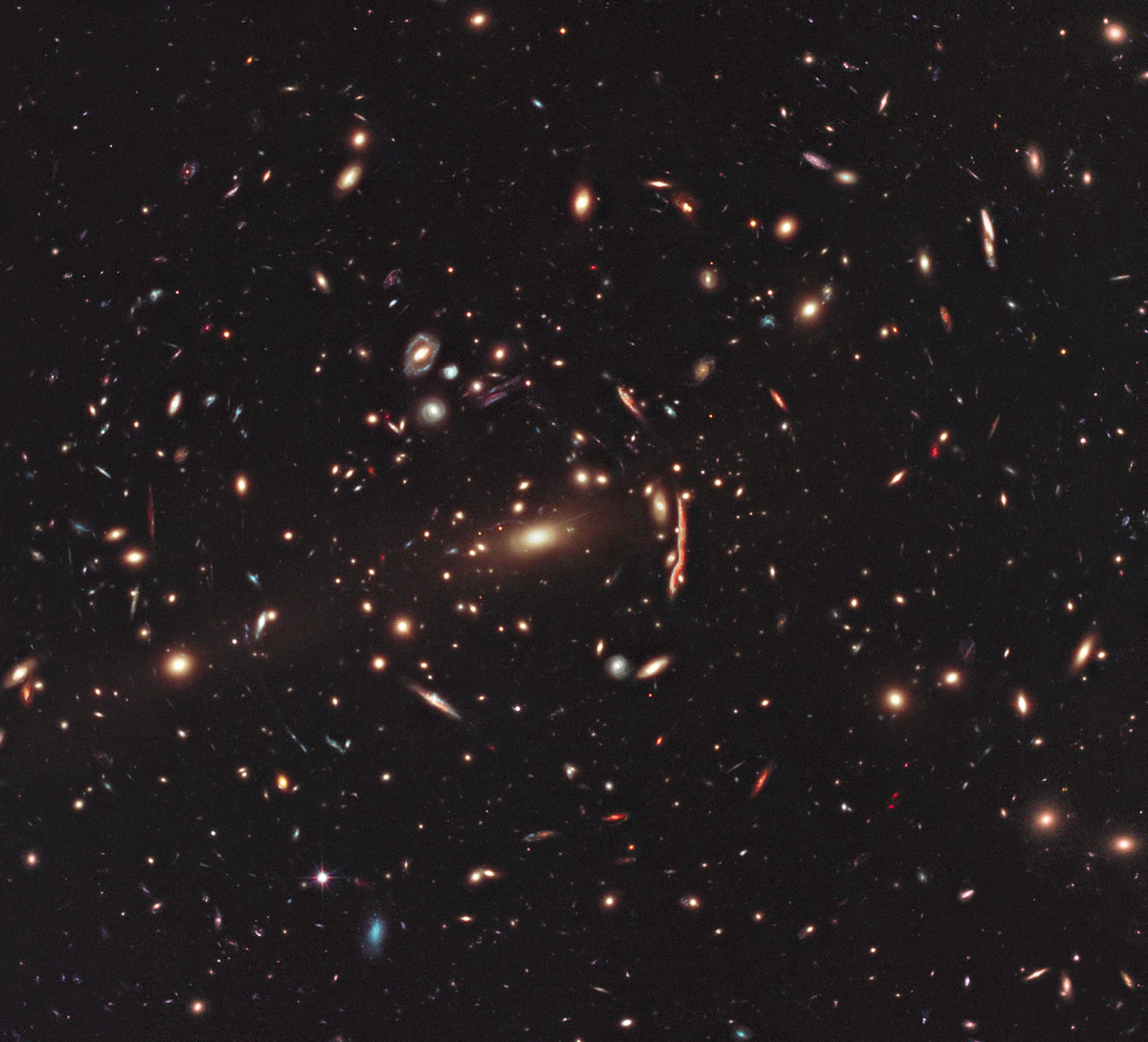
Before I do anything else, I simply have to present this insanely cool Hubble image of the galaxy cluster MACS J1206, which lies at the mind-numbing distance of 4.5 billion light years from Earth:CLICK HERE FOR THE REST OF THE ARTICLE (Trust me, you WANT to do this).
[Click to enclusternate, or grab the bigger 2564 x 2328 pixel version.]
Like I said, insanely cool. The cluster has thousands of galaxies in it, and a total mass of something like a quadrillion — that’s 1,000,000,000,000,000 — times the mass of our Sun!
The image was taken as part of a program called CLASH, for Cluster Lensing And Supernova survey with Hubble. A large group of astronomers from ten different countries are observing more than two dozen such distant clusters to look for many interesting things, including exploding stars (which help us gauge the expansion rate of the Universe), very distant galaxies (to help us understand the early Universe), and to look for dark matter.
Dark matter is stuff that doesn’t emit light, but has mass. Careful observations over the years have ruled out pretty much every form of normal matter we can think of, from simple hydrogen clouds to black holes. Whatever this stuff is, it’s weird, not matter as we know it.
Okay, on to the next article. And truth be told, I think this one is actually much cooler than the first one. Just because it deals with so many things so far back in time that it simply boggles the mind. Especially when you consider how much we have indeed figured out, and been able to observe. And we continue to figure out more and more as time passes. I keep hearing all sorts of gaps slamming shut all the time. Sadly, it appears that too many people are deaf (and blind), and still adhere to bronze age myths passed down by illiterate goat herders... I much prefer reality, even if it makes me small and totally insignificant. I relish that we still strive to understand!
CLICK HERE TO READ THE REST OF THE ARTICLE (Again, you really, really NEED to do this!).Astronomers have found when and how the cosmic fog was lifted
Take a look at the image displayed here [click to redshiftenate]. Every object you see there is a galaxy, a collection of billions of stars. See that one smack dab in the middle, the little red dot? The light we see from that galaxy traveled for 12.9 billion years before reaching the ESO’s Very Large Telescope in Chile. And when astronomers analyzed the light from it, and from a handful of other, similarly distant galaxies, they were able to pin down the timing of a pivotal event in the early Universe: when the cosmic fog cleared, and the Universe became transparent.
This event is called reionization, when radiation pouring out of very young galaxies flooded the Universe and stripped electrons off of their parent hydrogen atoms. An atom like this is said to be ionized. Before this time, the hydrogen gas was neutral: every proton had an electron around it. After this: zap. Ionized. This moment for the Universe was important because it changed how light flowed through space, which affects how we see it. The critical finding here is that reionization happened about 13 billion years ago, and took less time than previously thought, about 200 million years. Not only that, the culprit behind reionization may have been found: massive stars.
OK, those are the bullet points. Now let me explain in a little more detail.
15 October 2011

13 October 2011
Eulogy for my Sister
As I mentioned in a previous post, my sister passed away recently. I set up a memorial fund for her kids (please visit the link and get the info). I also delivered a eulogy for her and I wanted to share it. The two youngest children do not know that this was a death by suicide, I had to actually alter what I had written to take out one of the central themes (i.e. not to lay blame) so that it wouldn't be disturbing to them. Here is the full text of the eulogy as I wrote it.
As I look to each of you, I see my own sorrow in your eyes. Behind the tears that fall for my sister, Susan, I see great love and admiration. I know that Susan would be humbled to realize that you’ve taken time from your busy schedule to join in celebration of her life and on behalf of our family; thank you for the support that you’ve offered at this difficult time.
If anyone asked Susan what her finest legacy to the world is, she wouldn’t have hesitated to say, “my family”. She was the proud mother of Cole, Sommer, Noelle, and Grace, and I hope that each can remember that while they have lost a link to the past with Susan’s death; they will always be her hope for the future. Albert Einstein once said, “Our death is not an end if we can live on in our children and the younger generation.” I’m comforted by the fact that Susan will be revered, loved and remembered for decades yet to come.
My sister was an intelligent, funny, strong willed, determined and vivacious young woman. She was a skilled labor and delivery nurse and loved her job. She enjoyed running and biking and was, by her own admission, an open book. She loved to laugh (often) and was spontaneous and fierce. While she seemed strong as steel, the reality is that she was as fragile as crystal and it is this fragility that brings us here today.
It seemed that Susan had it all. She was at the top of her professional years and had many more years to live and many more lives to influence. Yet she faced internal demons none of us even knew of. Many of us feel a selfish guilt right now. We are not just wondering “why” but we are wondering “what”….What could we have done? In the end, as long as we were good and faithful friends to Susan, we did all that we could do. One of the glories of being human is that we get to make choices, and while I don’t agree with my sister’s choice to end her life; it is one she made, and in the end, my wish is that she has found the peace she was looking for.
I don’t think of my sister in the past tense because she is always going to be a part of my memories. I will always remember my younger sister as an inspiration and gift in my life and I am going to miss her more than words can say.
I don’t harbor anger or resentment towards Susan for her final act. She was ill and she did not get the help she needed. Maybe her self reliance and determination prevented her from admitting this illness to herself, thus disallowing necessary help.
Death is the final equalizer for all of us. For most, death comes naturally after a life of many decades. To some life is cut short through no specific plan of an individual through disease or accident. Sadly, others suffer from a misunderstood disease of mental illness and they lose perspective on life and irrationally end it for themselves.
There is so much we don’t know. We don’t know what led her to think that she had no other choice and we wonder at the despair that at last got out of hand and drove her towards her decision.
But…we are not here to hand out blame. Adlai Stevensen once said, “It is not the years in a life that counts; it is the life in the years.” I will be the first to tell you that Susan packed a lot of life in her years and it is that very life that we celebrate today.
An example of her determination, iron will, and the life she led. During the lobster festival in Maine, they have a lobster crate race. Susan tackled that race with her usual gusto. She had clearly won the race, but she kept going. Even after she set the record for that race, she kept going. Not satisfied with just breaking the record, she wanted to make that record her own. She kept going to the point of exhaustion and made that race her own personal property! That record stood for well over a decade. That is the type of person that I will always carry with me.
Moving into the future without Susan by our side will be odd. However, as long as one is remembered they are not truly dead, and if we carry memories of Susan in our heart, she will be with us always.
In her memory, I would like to read a poem written by Edwin Harkin of the UK, in 1981. I think Susan would have liked this:
You can shed tears that she is goneor you can smile because she has lived.
You can close your eyes and pray that she’ll come backor you can open your eyes and see all she’s left.
Your heart can be empty because you can’t see heror you can be full of the love you shared.
You can turn your back on tomorrow and live yesterdayor you can be happy for tomorrow because of yesterday.
You can remember her and only that she’s goneor you can cherish her memory and let it live on.
You can cry and close your mind,be empty and turn your backor you can do what she’d want:smile, open your eyes, love and go on.
Rest well, Susan. I miss you terribly.
11 October 2011
Facts are not beholden to opinions
The season of "I'll say anything to get a job" is now in full swing. Others call it election season, but hey, we all know what it is. The sad part about this though is that some of the things that these critters are saying is just outright false. You have such crazy doozies as Michelle Bachman totally leaving the reservation of reality (but then that's to be expected). Rick Parry is equally as loony, and Donald Prothero at Skepticblog tackles some of that. I figured that I'd pass some of that info along. I suppose it must be especially bad if Fox News is actually calling you out on it (the emphasis is mine)!
It happens so often that we are inured and desensitized to it. Creationists spout lies and distortions about science and reality, and no one disputes them (except an occasional high school student who challenged Michele Bachmann’s assertion that Nobelists denied evolution). Politicians like Rick Perry and Bachmann get up and brag about their doubts about the reality of global climate change and evolution, and they become the darlings of the GOP. Partisan media like Fox News and their parent company NewsCorp admit that they are receiving money from GOP candidates, or funneling it to them, and no one seems to care. News Corp and Rupert Murdoch get away with all sorts of outrages in their tabloids, yet they are so powerful that British politicians and cops dare not cross them—until their actions are so extreme that all of the UK is disgusted with them. But every once in a while, the cat is let out of the bag, and someone says something that reveals how these people are either abysmally ignorant of reality because of deluded ideology, or they are smart enough to recognize it but play along in a cynical grab for power over those who are ignorant or ill informed.CLICK HERE TO READ THE WHOLE BLOG ENTRY! Please do, he says some really pertinent things. There is also a series of quotes at the start of his blog article that are all worthwhile reading. As a matter of fact, these quotes lead directly to a post made by Phil Plait over at Bad Astronomy that is right in line with this. He has a post he calls GOP senior officials quietly trying to restore science to their agenda which I think is worth reading:
The latest incident occurred when two pundits on Fox News were discussing the GOP candidates. They point to Jon Huntsman as the sole candidate who would admit that global warming is real (Romney, Gingrich, and others who also once admitted it are now backtracking to kowtow to the extremists who vote in GOP primaries and caucuses). They comment that he’s losing ground to Rick Perry, who made false claims not only about global warming but also about how scientists were allegedly committing fraud. One of the Fox anchors, Clayton Morris, says it it in no uncertain terms:
Certainly, if you dive into the weeds a little bit on this global warming thing, you see that it seems the facts are certainly on Huntsman’s side on all of this and fact checkers have come out, and we’re actually having our own brain room look at this right now, that any of Perry’s comments don’t seem to hold a lot of water. But it doesn’t matter, because what’s resonating right now in South Carolina is helping Governor Perry tremendously. He fired back at Huntsman on global warming and gaining traction, facts or not.
If you’ve read this blog for more than a few nanoseconds, you know how incensed I am over the blatantly antiscience trend in the Republican leadership. As I have pointed out before, supporting the reality of global warming or evolution is akin to political suicide if you are a candidate for office in the GOP. The attacks on science by the far right are not new, but the openness and outspoken nature of it are fairly recent. Even Newt Gingrich, who used to a be a strong supporter of science, is making Michele Bachmann-level misstatements about it.CLICK HERE TO READ THE REST OF THE BLOG ENTRY. Even though Secretary Schultz messed up the Senator Moynihan quote a bit, I was glad to see this. As I lamented a while back, it's sad that adhereing to reality is a career killer for a GOP candidate...
So I was very glad to read an article at the National Journal saying that older leaders of the Republican party are trying to re-establish the role of science in the GOP:
But quietly, many acknowledge a deepening GOP schism over the issue, as many moderates grow increasingly disturbed by their party’s denial of proven science. A number of influential Republicans who have left the battlefield of electoral politics are now taking action in an effort to change the GOP’s stance.And we’re not talking about lightweights, either. People like former (under Bush I) Secretary of State George Shultz, who said this:
"My own opinion is that this [climate change] problem is very real," Shultz told National Journal. "I recognize there’s a lot of people pooh-poohing it. Whether they like the science or not, there’s a huge problem coming at us. There’s a huge melt coming in the Arctic regions. There’s melting taking place." Of Republicans like [Presidential candidate Rick] Perry who deny climate science, he said, "They’re entitled to their opinion, but they’re not entitled to the facts."
09 October 2011
Just Existing Makes Atheists Dicks
Well, it would seem that way... The following story was posted at Freethought Blogs by JT Eberhard. The whole story reminds me of a similar experience. A while back I had put together a presentation on the Spirit and Opportunity rovers, and I wanted to do a bit of a public outreach on science to the local community in the Panhandle* of Florida (Niceville to be exact). I mentioned this in the local paper's community forum, made a blog post there about it, and put up a poster at the library.
Come the night of my presentation, no one showed up. After 15 minutes of putting up pretty pictures of Mars and photographs the rovers had taken, I was finally approached by a few adults. They kindly (in that totally hypocritical, covered in sugar, I'd like to see you burn in hell kind of way they do in the south) asked me to remove the posters and please leave. They didn't want any of "the devil's science to taint the purity of their children." You can't make this shit up!
Anyway, on to the letter at Freethought Blogs:
This particular person's story really does show the fight anyone who isn't a christian is in for. And woe unto those who are atheists (which is worse than being a muslim to them). So just be simply existing we are somehow offensive to them. And don't we even dare advertise that we exist! The fervor and indignant rage that boils up whenever an atheist billboard goes up is almost as if we had posted a picture of atheist lesbians masturbating with bibles! Well, if we're offensive, it's just too fucking bad! At least we don't follow some misogynistic bunch of bronze age fables that truly are offensive. Of course, asking that sort of introspection is also offensive, right?
*By the way, has anyone else noticed that any state that has a "Panhandle" is fundamentally fucked up?
*** I had mentioned some petitions of interest to anyone who understands the secular nature of our nation:
Also, don't forget about this petition to the White House to at least treat military atheists equally
Make E. Pluribus Unum our official motto.
Remove "Under god" from the Pledge of Allegiance.
Remove "In god We Trust" from currency.
Stop Federal Funding and Support of BSA (for their bigoted discriminatory rules).
Remove tax exemption from churches and allow them to apply like a non-profit organization (Especially when they engage in direct political activities)
Come the night of my presentation, no one showed up. After 15 minutes of putting up pretty pictures of Mars and photographs the rovers had taken, I was finally approached by a few adults. They kindly (in that totally hypocritical, covered in sugar, I'd like to see you burn in hell kind of way they do in the south) asked me to remove the posters and please leave. They didn't want any of "the devil's science to taint the purity of their children." You can't make this shit up!
Anyway, on to the letter at Freethought Blogs:
This past weekend I had an experience I wanted to share with everyone. In the past, I would have simply done so on my own blog, but as I’ve become a public person and my chances of finding and keeping a job in my profession depend on me not being the outed atheist I have been in the past, I’ve tended to downplay such posts over the past few years. But the experience this weekend was too frustrating not to use to make a point that many in the atheist movement, have been hammering at for a long while now.
I have a tendency to do quite a bit of science outreach and this past weekend, I set up a telescope in a public place. I had a large number of people stopping by and my objective was just to let them look and marvel. I’d answer questions, but I wasn’t out to shove science factoids at them, and absolutely wasn’t going to bring up religion. Yet at one point, it happened. It wasn’t a theist that did so, but another of the bypassers that made some off hand comment that didn’t make room for any sort of God. A theist, standing nearby objected and although I’m not quite sure how (I was too busy having to adjust the telescope) they got onto the topic of Jesus invalidating the laws set forth in the Old Testament.
This is where I jumped in on the conversation. I pointed out that this depends on who you ask. Most Christians accept this, yet others note that Jesus at some point mentioned that Jesus claimed to come to “uphold his Father’s word”. This is an argument I’ve heard from several preachers. It’s often the basis for maintaining emphasis on Levitical laws to hate on gays. As such, the blanket statement from the theist, that Christianity as a whole rejects the OT laws and that he could treat his interpretation as the one true version. I made a few other quick notes that what various sects of Christianity, and other faiths that draw their basis from the Torah, deem as important varies wildly. And that was the end of the conversation at that point.
Yet a few hours later, as I packed up my telescope, the theist came walking by and asked why I was so “hostile to Christianity”.
I admit that I stumbled on this one. I didn’t think that I had been. I hadn’t in any way said that it was wrong, or even he was wrong. I only noted that there’s lots of interpretations on a vague source and no way to know if they were correct. He responded, not by disagreeing, but instead calling me “arrogant”, “close-minded” and “elitist”.
I’ll skip the part with all the other tropes where he tried to claim that science was just another religion, or that evolution didn’t have evidence, or the fossil record was incomplete, or that we’d never seen species diverge, and that Christians are horribly persecuted. I think we all know silly these arguments are. If you don’t, leave a comment and I’m sure someone will come along and explain it.
I’m not going to get into those because they really don’t phase me. They’re lies that are taught by religion that theists have never been taught to critically analyze so they blindly parrot. I really can’t blame them; religion is convincing and skeptical thinking isn’t taught in schools.
What does bother me is the attempts to claim that I was being “hostile”, “arrogant”, “close-minded”, and “elitist”. And here I thought I’d been being damn accommodating. I didn’t make the claim there was no God. I didn’t insult him personally. I just mentioned that there were many interpretations within the Christian faith. This is a simple fact that I would think is broadly recognized.
Yet it’s enough to make Christians feel attacked and lash out, playing the victim card, claiming that atheists are being mean.
And that’s the point I want to get at.
Phil Plait says not to be a dick.
I wasn’t.
But I was perceived as one.
This, and countless other experiences show that accommodationism doesn’t work. We don’t have to actually attack religion to be offensive. Simply existing will do it. And as this experience shows, even mentioning that other Christians may disagree will do it. It’s not atheists that scare them. They’ve been taught to fear every shadow, including their own.
In many equal rights movements, we hear about how simply the fear of being thought of as different will effectively silence the oppressed. “Gay baiting” (the practice of insinuating an opponent is gay in an effort to shame them so others stop listening) is a perfect example of this. Events like this are a direct parallel. Atheists are being shamed into silence for fear of being a dick. Even when they do discuss it, we often substitute other words like “skeptic”, or hide behind the “agnostic” label.
All because we don’t want to be a dick.
And that’s a damned shame. It’s a shame that pointing out something as mild as “Christians disagree” makes me a dick. And it’s a double damned shame that such things are so offensive that I’m asking JT to post this, because my employment may depend on not being even perceived as a dick.
We’re in a catch 22 here, which is exactly what the theocratic superpower wants.
What do I make of this? The lesson I’ve been so starkly reminded of here is that I can’t worry about being a dick when placed in such a situation. If I’m going to be thought of one no matter what, I should make the best, most devastating arguments possible. Someone else might be listening.
Which is exactly what happened this weekend. During the entire exchange, a young girl (who later told me had just started college) was listening. She approached me afterward and told me she could see where the better argument lie and that, having grown up in a tiny town, she had never seen anyone able to stand toe to toe with someone so adamant about their religion. I didn’t ask if she was religious. I didn’t need to. Even if she was, it was clear that the exchange left a deep impression.
And that’s what is important. We can’t let ourselves be shamed into silence because of some people that toss up their defensive distractions, calling people arrogant and elitist, whenever challenged. Because people are listening. And whether some people get freaked out over it, being right actually works.
This particular person's story really does show the fight anyone who isn't a christian is in for. And woe unto those who are atheists (which is worse than being a muslim to them). So just be simply existing we are somehow offensive to them. And don't we even dare advertise that we exist! The fervor and indignant rage that boils up whenever an atheist billboard goes up is almost as if we had posted a picture of atheist lesbians masturbating with bibles! Well, if we're offensive, it's just too fucking bad! At least we don't follow some misogynistic bunch of bronze age fables that truly are offensive. Of course, asking that sort of introspection is also offensive, right?
*By the way, has anyone else noticed that any state that has a "Panhandle" is fundamentally fucked up?
*** I had mentioned some petitions of interest to anyone who understands the secular nature of our nation:
Also, don't forget about this petition to the White House to at least treat military atheists equally
Make E. Pluribus Unum our official motto.
Remove "Under god" from the Pledge of Allegiance.
Remove "In god We Trust" from currency.
Stop Federal Funding and Support of BSA (for their bigoted discriminatory rules).
Remove tax exemption from churches and allow them to apply like a non-profit organization (Especially when they engage in direct political activities)
07 October 2011
Astronomy: Another demotion to come (We're not unique)
The last post I did should have been a bit of perspective to our place in the universe (i.e. we are in no way centrally located). This knowledge should be known by all humans on this planet after a series of great demotions as Carl Sagan called them. However, I think it's valuable to remind everyone that we are far from unique in this universe. The Kepler mission is out there looking for planets that could be a lot more like ours than any others we have found. Now, the geometries involved here mean that very few (relatively speaking) are actually going to be detected. Or as they say:
And what we know of evolution and life here on earth (particularly in regards to its resilience and ability to pop up just about anywhere), it's a safe bet that life out there will be relatively common. Granted, we only have a smaple size of one at the moment. However, should we find evidence on Mars or Europa for instance, that will really open the field up. With the possibility of life being pretty common, that begs the question of intelligent life out there. We (notionally) have a smaple size of one on this too. Sadly, the factors involved in our ascent to (supposed) intelligence are unknown and very difficult to translate to any other of a myriad of possibilities. But given the large numbers involved, I'm pretty sure they are out there. I just highly doubt we'll ever get to talk to any of them.
And just to leave you with another preliminary paper about the probability of earthlike planets out there, Dr. Phil Plait covers this as well:
Geometric ProbabilityWhich is why the Kepler results really are in line with what we know of the universe. Kepler has been up there for a short while, and has a possible list of nearly 2000 planets just looking at about 150,000 stars for only a couple of years! So if only 1% statistically transit, that would mean that just randomly 1500 systems would have the correct orientation (given the results to date, that makes sense). And given that about 7500 stars were eliminated from consideration due to being variable of one sort or another... I think it would be pretty safe to say that pretty much every star out there has at least some sort of planetary body around it.
Transits can only be detected if the planetary orbit is near the line-of-sight (LOS) between the observer and the star. This requires that the planet's orbital pole be within an angle of d*/a (part 1 of the figure below) measured from the center of the star and perpendicular to the LOS, where d* is the stellar diameter (= 0.0093 AU for the Sun) and a is the planet's orbital radius.
This is possible for all 2pi angles about the LOS, i.e., for a total of 4pi d*/2a steradians of pole positions on the celestial sphere (part 2 of figure).
Thus the geometric probability for seeing a transit for any random planetary orbit is simply d*/2a (part 3 of figure) (Borucki and Summers, 1984, Koch and Borucki, 1996).
For the Earth and Venus this is 0.47% and 0.65% respectively (see above Table). Because grazing transits are not easily detected, those with a duration less than half of a central transit are ignored. Since a chord equal to half the diameter is at a distance of 0.866 of the radius from the center of a circle, the usable transits account for 86.6% of the total. If other planetary systems are similar to our solar system in that they also contain two Earth-size planets in inner orbits, and since the orbits are not co-planar to within 2d*/D, the probabilities can be added. Thus, approximately 0.011 x 0.866 = 1% of the solar-like stars with planets should show Earth-size transits.

And what we know of evolution and life here on earth (particularly in regards to its resilience and ability to pop up just about anywhere), it's a safe bet that life out there will be relatively common. Granted, we only have a smaple size of one at the moment. However, should we find evidence on Mars or Europa for instance, that will really open the field up. With the possibility of life being pretty common, that begs the question of intelligent life out there. We (notionally) have a smaple size of one on this too. Sadly, the factors involved in our ascent to (supposed) intelligence are unknown and very difficult to translate to any other of a myriad of possibilities. But given the large numbers involved, I'm pretty sure they are out there. I just highly doubt we'll ever get to talk to any of them.
And just to leave you with another preliminary paper about the probability of earthlike planets out there, Dr. Phil Plait covers this as well:
A paper has been accepted for publication in a science journal (PDF) where the author has analyzed data from NASA’s Kepler planet-finding observatory, trying to figure out how many Earth-sized planets there might be in the galaxy orbiting their stars in their habitable zones; that is, at the right distance so that the star warms the planet enough to have liquid water. In the paper, he estimates that on average 34% (+/-14%) of Sun-like stars have terrestrial planets in that Goldilocks zone.CLICK HERE TO READ THE REST OF THE POST.
34%!
I can explain how he got this number. But I can also explain why I think this needs to be taken with a grain of salt. Let me be clear: it’s possible he’s right, and I suspect he may very well be. His math looks good to me. But a couple of assumptions he had to make need to be pointed out, and I want that to be clear before the media start running around saying there are billions of Earths in the galaxy based on this.
Here’s the deal. Kepler is an orbiting observatory that’s staring at about 100,000 stars, looking for dips in their light when an orbiting planet passes in front of them from our perspective. The length of time the dip takes gives us the orbital period of the planet, and the size of the planet (if the star’s size is known, generally true) can be determined by how much light is blocked. I talk about how this works in a little more detail in an earlier post.
06 October 2011
A Tragic Loss (The death of my sister, and college funds for her kids)
I would love to believe that when I die I will live again, that some thinking, feeling, remembering part of me will continue. But much as I want to believe that, and despite the ancient and worldwide cultural traditions that assert an afterlife, I know of nothing to suggest that it is more than wishful thinking.Yesterday I found out that my sister took her own life. It was a very sad shock and a huge tragedy. Personally, as an atheist, all the evidence supports the position that once electro-chemical processes stop in the brain, that's it. That person is no more, and no one will ever be able to interact with them in any way ever again. It is the final equalizer for us all. For most, death comes naturally after a life of many decades. To some it is cut short through no specific plan of an individual through disease or accident. And sadly, some suffer from a misunderstood disease of mental illness, and they lose perspective and irrationally end it for themselves.
The world is so exquisite with so much love and moral depth, that there is no reason to deceive ourselves with pretty stories for which there's little good evidence. Far better it seems to me, in our vulnerability, is to look death in the eye and to be grateful every day for the brief but magnificent opportunity that life provides.
- Carl Sagan "In the Valley of the Shadow" PARADE magazine (10 March 1996)
I am of course very sad about this news. My sister was a very intelligent, funny, strong-willed, determined, and vivacious young woman. All those attributes are generally not ones you would think of for someone who would take their own life, yet she did. I find that I harbour no anger or resentment towards her for this final act. She was indeed ill, and she didn't get the help she needed. Maybe her self reliance and determination prevented her from admitting to herself her illness and actually seeking the help she needed. She had been in an opportunity to be evaluated for mental health help, however, as a nurse (and a smart one at that), I am sure she was able to provide the doctors with the answers to their questions that would allow her to leave the psychiatric evaluation facility with minimal follow up. If anything, I feel anger towards that institution more than anything else.
I am most concerned for her children though. Susan had a very tumultuous life, and her children were really the one stabilizing factor for her. They are wonderful kids, and this isn't the sort of thing that any child should have to deal with. In celebration of her life, I am setting up an educational fund for her kids. If you wish to donate, here are the details:
Send a check or money order to (these are 529 plans, so they may be tax deductible depending on your state):
USAA College Savings Plan
(Susan L. Carroll Memorial Fund)
P.O. Box 55354
Boston, MA. 02205-5354
1-800-531-8722 Extension 24992
If you have a U Promise account, you can link to these as well. You will need to specify the accounts you want the funds to go into (or ask them to equally disburse the funds):
Cole: 505293251-01
Sommer: 505293251-02
Noelle: 505293251-03
Grace: 505293251-04
If you have questions or concerns, please call the phone number above, or you may contact me and I'll see what I can do to help.
P.S. I have several blog entries already in the queue. I think I will let them auto-publish over the next few days. This is not out of insensitivity or anything. I just figure that since we only have this life, I should not go out of my way with grief, but instead draw on the support of friends and family, and manage to continue living my life as a testament to its value. I hope you can understand that.
05 October 2011
The Known Universe by American Museum of Natural History
Watch this in full size! That is all I have to say about that.
This is home sweet home. The only one we have, and probably will ever know. We may learn about others out there, but they will only be dots in the sky that we learn about in books and through science. This one is the one we need to take care of, because fuck it all, we're really screwing this one up for ourselves.
I think over the next few days, I will post a few more things that really show how small and insignificant we really are. The universe doesn't give a damn about us, nor does the galaxy, the solar system, or even the planet. We are wholly responsible for our own fate, and we are being total fucktards about it as a species because the 0.1% that think they are in charge of everything haven't a fucking clue what they are doing.
This is home sweet home. The only one we have, and probably will ever know. We may learn about others out there, but they will only be dots in the sky that we learn about in books and through science. This one is the one we need to take care of, because fuck it all, we're really screwing this one up for ourselves.
I think over the next few days, I will post a few more things that really show how small and insignificant we really are. The universe doesn't give a damn about us, nor does the galaxy, the solar system, or even the planet. We are wholly responsible for our own fate, and we are being total fucktards about it as a species because the 0.1% that think they are in charge of everything haven't a fucking clue what they are doing.
Sign This Petition!
This petiton needs signatures! It doesn't matter if you are atheist, or religious. As an atheist (former) service-member ALL service members should be protected from overt discrimination or punishment under EEO policies that are established, but oft ignored. If we can't get a commanding officer torespect the religious freedom of his subordinates, how can we trust him to stand up and fight for our country’s promised freedoms? We can't!
Ed Brayton at Freethought Blogs has a post about how non-religious service members are treated on a regular basis, and it doesn't seem to be getting better. Here is what he has to say, with a couple of examples:
Ed Brayton at Freethought Blogs has a post about how non-religious service members are treated on a regular basis, and it doesn't seem to be getting better. Here is what he has to say, with a couple of examples:
ORIGINAL POST HERE!Justin Griffith documents some of the treatment of non-believing soldiers who resist being forced into going to religious services by their superiors. A former Marine NCO writes to him about his experiences in boot camp when he requested permission not to attend church services on Sundays. As usually happens, he was forced to clean the barracks instead; he was also berated repeatedly by his drill instructors.
July, 7th 1998 I went to Marine Corps Basic Training in San Diego, CA. Shortly after being assigned to Platoon 1103 and meeting our Drill Instructors, the first Sunday of my enlistment rolled around. We sat in one of the theaters and listened to a Chaplain speak, telling us that they offered services for almost any form of religion and that after he was finished we were to get in line for our appropriate religion. He also said that there was a non-denominational group that would discuss our relationship with god. Lastly he said that we did not have to attend any church services if we did not want to.As Justin notes, this is a story that you hear constantly from atheist soldiers. The experience seems to be so routine as to almost be a matter of official military policy. This particular soldier was even arrested for refusing to attend a religious service, though no charges were filed because the arrest was clearly illegal.
I looked for the “not attending church” line, but could not find it. I was instead ordered to line up in the non-denominational line.
I sounded off, “Sir, This Recruit requests permission to not attend church services, Sir!”
Another platoon’s Drill Instructor interrogated and berated me for quite some time as I continued to respond with that phrase. Finally he gave in and took me back to the barracks where my Drill Instructor did the same. Eventually he too gave in and put me to work cleaning different areas of the barracks.
My Senior Drill Instructor (a church choir singer and devout christian) was then informed. He attempted the interrogation and berating, having the same effect. Later he had both a private and a public “Hats off” more polite conversation urging me to attend church services. Again I sounded off with the phrase that became my mantra. ”Sir, This Recruit requests permission to not attend church services, Sir!” He then seemed to want nothing to do with me since I wouldn’t “Do this for him.”
At least he stopped trying to force me to go.
Here’s Justin’s own story:
There are two choices we can make when faced with this in boot camp.This is why what Justin is doing in organizing Rock Beyond Belief and and in giving a voice to all atheist soldiers is so important. Atheist soldiers can no longer just sit back and take the abuse, they must speak up if they have any hope of ending it. By holding that event at Ft. Bragg, we are getting the attention of the Pentagon and letting them know that the rights of atheists are just as important as the rights of Christians — and that we’re going to be watching to make sure they get the point.
1) Clean up and get yelled at every week – a punishment for not believing in god. 2) Go to a religious service and tune it out.
I tried both. I was not allowed to write letters, sleep, or even sit down. If for even one second I wasn’t actively cleaning, the Drill Sergeants would throw sand across the (freshly) waxed floor, or otherwise punish me. They get really creative. I was a special case because just before graduation, I was seriously injured. This extended my stay from the standard 9 weeks to a grueling 30-something weeks long.
03 October 2011
The Guardian: Rising atheism in America puts 'religious right on the defensive'
According to The Guardian, atheism (or more specifically secularism) is on the rise in the United States. Particularly with younger folks. I guess since all these younger folks aren't responsible for most of the politics or TV programming, I guess we still have to put up with the likes of Rick Parry and all the smarmy televangelists or hateful preachers, but there may be hope for the future. They do point out the statistics that we are starting to hear more an more about. It's funny that someone would discount 15-20% of the electorate like the nutbag theocrats are doing, but then just as well. Although I really wish they wouldn't have success at the local level which seems to embolden them to think that the rest of the world is just like their little fantasy neighborhood they just crawled out of...
The US is increasingly portrayed as a hotbed of religious fervour. Yet in the homeland of ostentatiously religious politicians such as Michele Bachmann and Rick Perry, agnostics and atheists are actually part of one of the fastest-growing demographics in the US: the godless. Far from being in thrall to its religious leaders, the US is in fact becoming a more secular country, some experts say. "It has never been better to be a free-thinker or an agnostic in America," says Annie Laurie Gaylor, co-president of the FFRF.I did get a particular kick out of one paragraph though (emphasis mine).
The exact number of faithless is unclear. One study by the Pew Research Centre puts them at about 12% of the population, but another by the Institute for the Study of Secularism in Society and Culture at Trinity College in Hartford puts that figure at around 20%.
There are other indications, too. For a long time studies have shown that about 40% of US adults attend a church service weekly. However, other studies that actually counted those at church – rather than just asking people if they went – have shown the true number to be about half to two-thirds of that figure.In other words; are the theitards lying for jebus again? If it wasn't so totally expected, and exactly the modus operandi they have been under for decades, I would be surprised (or maybe I wouldn't).
02 October 2011
16 Things Atheists Need Christians to Know
I am filing this under humour only because it really is very much tongue in cheek (and besides, associating knowledge with a theists? Who are we kidding? They will continue to blindly parrot their assertions and stick to their silly preconceived notions of how the world works.) Was that parenthetical too snarky? Well, fuck them them if they have their feelings hurt...
I just happened to find this over at the I Am An Atheist website, and it was making the rounds on facebook and other places, so I wanted to add in my amusement at the whole thing. Here it is:

 Please stop hedging when you mention our lack of belief. Atheists are atheists. We're not "self-described," nor do we "claim" to be atheists. You don't want us to start saying things like, "This is my friend, Julie. She calls herself a Christian," do you? Then man up, brace yourself, and use the a-word all by itself. Practice in front of the mirror if you need to. You'll know you have the proper calm, factual tone when the glass doesn't shatter.
 Please stop capitalizing the word "atheist." Unless it comes at the beginning of the sentence, you're just wasting ink. We know you're probably trying to be polite, but it doesn't work that way. There is no guy named Athe.
 Some of you keep insisting that we're angry at your god. And then you laugh at us for being so silly – being angry at someone we don't even believe in. Well, you're right. That would be pretty darned silly. That's why we don't do it. Are you annoyed at Zeus? Do you have a grudge against the faerie folk? Of course not. It's the same for us – how could we feel anger or hatred toward a non-existent being? (Some of his followers cheese us off, but that's another story.)
 Stop saying that deep down inside, we really do believe in your deity. Belief in the kind of guy who can create an entire universe with the force of a few well-turned phrases is not the sort of secret that fits neatly into a back pocket, as it were. If we thought this fellow was real, we'd be the first to know. And people don't tend to keep that particular nugget of information to themselves. Ever notice that?
 Please understand that "You're such a nice person! I can't believe you're an atheist!" is not a compliment. More importantly, please understand that we understand that. Believe me, every single one of us has considered replying, "And you're so smart – I can't believe you're a Christian!" How about we all agree to not go there?
 The only thing all occupants of foxholes have in common is access to weapons and a willingness to fight. It might be the better part of wisdom not to provoke them by insisting that you know more about their beliefs or lack thereof than they do.
 How can our lives have any purpose without God? One word: chocolate.
 It's sweet of you to worry about us, really it is. But it's not terribly helpful to tell us that we should go ahead and believe in your particular faith "just in case." Just in case what? In case a deity who can't distinguish heartfelt faith from apple-polishing affectation happens to be running the show?
 Let's make a deal: we promise to stop asking that stupid question about whether God can make a rock so big he can't lift it. In exchange, please stop saying, "Well, God doesn't believe in atheists!" and then laughing like Shakespeare came back to life just long enough to write one last comedy.
 Please quit asking us how or why we "turned our backs" on God. The whole point of being an atheist is that we don't see any reason to think we did any such thing.
 Anyone who was born in an English-speaking country and is more than two minutes old has heard about God and Jesus. It's annoying when you assume that atheists just haven't heard enough about them, and that's why we're still atheists. Many of us have done extensive research on the subject of religion. Many of us credit our atheism to exactly that.
 Please stop telling your atheist acquaintances that you'll miss us when you get to heaven. No, you won't. If you turn out to be right, you'll be in heaven – the place where, by definition, people don't feel sad. And if we're right – well, guess who won't be feeling much of anything?
 If you've ever said, "You can't prove there isn't a God" – first of all, congratulations. You're officially four years old. Second, we never said we could. But until you can show some serious proof that there is one, we see no reason to believe. There's nothing wrong with taking a leap of faith, provided you acknowledge that's what you're doing. Atheists simply prefer other forms of exercise.
 Stop asking us how we can be moral without God. It's simple. We're awake, and we're not idiots. That's all it takes to figure out that sharing the planet with so many other people is a lot more pleasant when we also share some basic ideas about acceptable behavior. I don't like being stabbed; therefore I support laws against stabbing and promise not to stab anyone myself, no matter how much I may feel like doing so. See how easy?
 So far as being a Christian is concerned, you're either a member of a persecuted minority, or part of a solid majority. Figure out which one of those is the case, and then live with it. You don't get to switch back and forth depending on whether you think you can smother dissent better at any given moment by either whining that everybody's always being mean to you, or bellowing that this is your house and you make the rules.
 Speaking of persecuted minorities: Christianity used to be one. Did you fight your way to freedom of faith just so you could treat nonbelievers the same way they used to treat you?
Can you guys think of any good clever things to add to this list?
I just happened to find this over at the I Am An Atheist website, and it was making the rounds on facebook and other places, so I wanted to add in my amusement at the whole thing. Here it is:
Guest essay by Deborah Markus
Please stop hedging when you mention our lack of belief. Atheists are atheists. We're not "self-described," nor do we "claim" to be atheists. You don't want us to start saying things like, "This is my friend, Julie. She calls herself a Christian," do you? Then man up, brace yourself, and use the a-word all by itself. Practice in front of the mirror if you need to. You'll know you have the proper calm, factual tone when the glass doesn't shatter.Please stop capitalizing the word "atheist." Unless it comes at the beginning of the sentence, you're just wasting ink. We know you're probably trying to be polite, but it doesn't work that way. There is no guy named Athe.Some of you keep insisting that we're angry at your god. And then you laugh at us for being so silly – being angry at someone we don't even believe in. Well, you're right. That would be pretty darned silly. That's why we don't do it. Are you annoyed at Zeus? Do you have a grudge against the faerie folk? Of course not. It's the same for us – how could we feel anger or hatred toward a non-existent being? (Some of his followers cheese us off, but that's another story.)Stop saying that deep down inside, we really do believe in your deity. Belief in the kind of guy who can create an entire universe with the force of a few well-turned phrases is not the sort of secret that fits neatly into a back pocket, as it were. If we thought this fellow was real, we'd be the first to know. And people don't tend to keep that particular nugget of information to themselves. Ever notice that?Please understand that "You're such a nice person! I can't believe you're an atheist!" is not a compliment. More importantly, please understand that we understand that. Believe me, every single one of us has considered replying, "And you're so smart – I can't believe you're a Christian!" How about we all agree to not go there?The only thing all occupants of foxholes have in common is access to weapons and a willingness to fight. It might be the better part of wisdom not to provoke them by insisting that you know more about their beliefs or lack thereof than they do.How can our lives have any purpose without God? One word: chocolate.It's sweet of you to worry about us, really it is. But it's not terribly helpful to tell us that we should go ahead and believe in your particular faith "just in case." Just in case what? In case a deity who can't distinguish heartfelt faith from apple-polishing affectation happens to be running the show?Let's make a deal: we promise to stop asking that stupid question about whether God can make a rock so big he can't lift it. In exchange, please stop saying, "Well, God doesn't believe in atheists!" and then laughing like Shakespeare came back to life just long enough to write one last comedy.Please quit asking us how or why we "turned our backs" on God. The whole point of being an atheist is that we don't see any reason to think we did any such thing.Anyone who was born in an English-speaking country and is more than two minutes old has heard about God and Jesus. It's annoying when you assume that atheists just haven't heard enough about them, and that's why we're still atheists. Many of us have done extensive research on the subject of religion. Many of us credit our atheism to exactly that.Please stop telling your atheist acquaintances that you'll miss us when you get to heaven. No, you won't. If you turn out to be right, you'll be in heaven – the place where, by definition, people don't feel sad. And if we're right – well, guess who won't be feeling much of anything?If you've ever said, "You can't prove there isn't a God" – first of all, congratulations. You're officially four years old. Second, we never said we could. But until you can show some serious proof that there is one, we see no reason to believe. There's nothing wrong with taking a leap of faith, provided you acknowledge that's what you're doing. Atheists simply prefer other forms of exercise.Stop asking us how we can be moral without God. It's simple. We're awake, and we're not idiots. That's all it takes to figure out that sharing the planet with so many other people is a lot more pleasant when we also share some basic ideas about acceptable behavior. I don't like being stabbed; therefore I support laws against stabbing and promise not to stab anyone myself, no matter how much I may feel like doing so. See how easy?So far as being a Christian is concerned, you're either a member of a persecuted minority, or part of a solid majority. Figure out which one of those is the case, and then live with it. You don't get to switch back and forth depending on whether you think you can smother dissent better at any given moment by either whining that everybody's always being mean to you, or bellowing that this is your house and you make the rules.Speaking of persecuted minorities: Christianity used to be one. Did you fight your way to freedom of faith just so you could treat nonbelievers the same way they used to treat you?Can you guys think of any good clever things to add to this list?
15 September 2011
Laws I would Enact...
First of all, I would never run for public office. Mostly because I don't think I have the right temperament for it (bullshit and assholes piss me off, and that's all congress seems to be made of). Also, as an atheist, I am pretty much totally unelectable... I know, it's a sad truth that somehow I am in America's most hated group (even though having served, I am also in one of the more trusted/respected groups...). Anyway, I do think that there are several laws that need to be passed (some of these are only half hearted jokes, but some of them I am serious about):
- Between the time the President's Budget is submitted, and Congress approves it, they shall not gather any pay, nor shall any pay be retroactively awarded. This no-pay period cannot be bypassed through legislation to increase Congressional salaries.
- All discretionary or supplemental riders to the President's submitted budget plan must be budget neutral through either cutting of another program or an appropriate tax increase.
- No Congressional salary increases shall take effect until after all legislators who voted on the bill have left office.
- The Debt Ceiling shall be eliminated. Instead, prior to passing any federal budget, if expenditures are greater than income, a statement shall be read and acknowledged by all members stating that they are also approving the required debt ceiling to pass this budget (that this should even need to be a law is incredibly silly, but this past August showed that it is apparently required...).
- When Congress authorizes any deceleration of war, there will be an automatically enacted "War Tax" which will cover the expected expenses beyond the currently approved DoD budget. Any military action taken by the President as Commander in Chief shall also enact a "War Tax" as to be budgetary neutral.
- Term Limits!
- Tort reform.
- Campaign finance reform.
- Since a corporation is considered a person for purposes of campaign contributions, it shall be treated as a person for applicability to all other laws as well. Much like you can't leave behind your hands or feet when you go somewhere, if any one individual of a corporation is subject to other laws, penalties, or restrictions, so shall ALL members of the corporation be equally subject to those laws. (In other words, someone gets busted for a DUI or something, everyone in the corporation faces the penalties... Hey, the corporation is a person, right?)
- If you wholly deny evolution, then you are only allowed access to medical technology as it existed prior to 1859. If you are convinced that evolution is somehow guided by something supernatural, then you are allowed medical technology as it stood in 1953.
- If you are a climate change denialist, you will be invited to move to Texas, Arizona, or Nevada and provided a free house sans air conditioning (okay this is the silliest one, but seriously how can one deny climate change in this day and age? (See this comic for my take on it even if you are anti-reality, why you should support cleaning up our act.)
- If you feel that any laws that protect the air, our food, product safety, etc. are a bad idea, a new chain of stores will be opened where you can buy products that have never been inspected.
12 September 2011
Them thar chickens coming home to roost is a bitch, ain't it Parry?
I could joke about how there is some sort of causality to the problems Texas is having with wildfires, and their governor's bahviour. However, I think instead, let's look at the sort of shit this idiot pulls, and then looks confused (a normal mental state for the man I think) as to why things are going poorly, even though at one time there were tools to help deal with this situation. The American Independent has a few words to say about this. I particularly noticed:
But while Perry complains about the feds’ response, he and Texas lawmakers have also been called to task for huge cuts to state firefighting resources passed earlier this year. The two-year budget that took effect last Thursday includes a 75 percent slash to volunteer fire departments — from $30 million to $7 million — and a one-third cut to the Texas Forest Service. State Sen. Kirk Watson (D-Austin) said this year’s fires near the capital city underscore the need to better fund the emergency-services districts stretched thin at the outskirts of Texas’ growing cities.And in case all the denialists legislators want to pass the buck and attempt to not accept at least partial blame:
Texas’ 879 volunteer departments are the first line of defense against wildfires for much of the state. The forest service, with 230 firefighters and 15 trucks, provides statewide support. After that, help comes from the federal government and other states.
In fact, the Texas firefighting force that’s battling flames right now is a result of a beefed-up budget approved by legislators in 2009, after the forest service succeeded in convincing lawmakers it was a wise investment. In 2008, Texas was coming off another serious drought, and a wildfire season two years earlier that required huge federal assistance including $34 million in FEMA grants.And in case Parry thinks this is just a one time thing, keep in mind:
In a funding request for 2010-2011, Texas Forest Service directors made a strong case for a bigger up-front investment from the state. “National mobilization costs 3-4 times per unit (a firefighter, a dozer) as it does to have our own state resources,” directors wrote, and take longer to arrive. “It takes three to five days to mobilize out-of-state resources. Our urgent resource requests could be efficiently alleviated if we had adequate state resources to rapidly attack and keep wildfires from turning into large, complex, multiple-day events.”
“We have examples of communities being burned because the state did not have enough resources,” directors wrote. The legislature responded with a $15 million bump in forest service funding, as the Fort Worth Star-Telegram reported in April.
This year, though, lawmakers rolled back the forest service budget, mostly by cutting its funding for grants that help volunteer fire departments buy new equipment.
Texas’ drought is no temporary arrangement, though, and the ongoing urban sprawl will ensure homes keep crawling farther out into wildfire territory.Yeah, I call this guy an idiot, and I think rightly so. It's his kind of anti-reality based fantasy thinking that will drag this country into third-world status faster than anything else.
But thanks to cuts made this year by the Legislature, when those fires start up next year, and the year after that, Texas’ volunteer fire departments will head out to battle those flames with the same trucks and gear damaged in this year’s fires.
11 September 2011
September 11th
I remember that I was getting ready to go fly that morning. I was in maintenance checking out the 781s and saw the news about the first plane (at that time assumed to be an accident). I actually watched it live as the second plane was deliberately flown into the South Tower. I told the rest of the crew that we would not be flying that day, and commenced to go into lock-down and was totally absorbed by the news like the rest of America. I know that all over there will be numerous remembrances, memorials, discussions, etc. It's sort of arbitrary that the 10th anniversary will cause so much reflection (because of our base 10 mathematical system), but I did see a specific passage that I couldn't agree with more:


Ten years have now passed since many of us first felt the jolt of history—when the second plane crashed into the South Tower of the World Trade Center. We knew from that moment that things can go terribly wrong in our world—not because life is unfair, or moral progress impossible, but because we have failed, generation after generation, to abolish the delusions of our ignorant ancestors. The worst of these ideas continue to thrive—and are still imparted, in their purest form, to children.


Subscribe to:
Posts (Atom)