My Actual Homepage - Go here for more info.


I plan to put a graphical banner here eventually...

02 August 2009

The 100% Solution: On Uncertainty, And Why It Doesn't Matter So Much

Again, found an interesting post by someone that sums up some great thoughts. I have highlighted a couple things that just make me wonder what the deal is with those who do claim such an absolute certainty. This entry reminds me of my 3 simple words (pt 1 and pt 2) blogs that I had a while back. So because we're pretty darn sure, it makes us arrogant, but because you have faith and KNOW your faith is true, you're not arrogant? Again, all part of the hypocrisy that seems to come so naturally in theistic thought... Anyway, on to the blog that is linked in the title as well:

There's a good piece over at Daylight Atheism, and I wanted to call it out and blog about it a little. It's called The Curiously Postmodern Modern Apologists, and it's about... well, the curiously post-modern twist that many modern apologetics for religion have been taking.

The gist of these apologetics: Nobody knows anything for 100% certain. Atheists and believers, scientists and philosophers: nobody can be 100% certain that the things they believe are true. Whether secular or religious, we all have some version of faith.

Therefore, religious faith is as valid as any secular kind. Believing in God, in angels, in reincarnation, in 72 virgins awaiting us when we die, in Jesus dying to save our souls, is every bit as valid as believing that the earth goes around the sun.

Let's take a look at this thought process, and see if we can spot the logical flaw.

The thought process goes like this:

100_percentOne: You can never be 100% certain that you're right about anything.

Two: Therefore, all ideas are equally likely to be true, and equally valid.

(Three: Therefore, my idea is right. But I think it's pretty obvious why that one's wrong, so I'm not going to bother shooting that particularly slow fish in that particularly small barrel.)

MatrixdvdOkay. First of all, Two does not follow from One. Yes, it's true, we can never be 100% sure of anything (except perhaps our own existence). The history of knowledge is full of mis-steps and false assumptions... and besides, everything we see and experience could all be an illusion. We could all be in the Matrix, or something.

But the fact that we can't be 100% sure of any idea doesn't mean that all ideas are equally likely or unlikely.

Earth_axisThe fact that we can't have 100% certainty doesn't mean that we can't assess which ideas are more or less likely. We can't know for 100% certain that the earth orbits the sun -- it could all be some horrible Satanic deception, or space aliens playing a practical joke -- but we can be pretty darned sure that it's very likely indeed. And we can't be 100% sure that Bertrand Russell's china teapot isn't orbiting the sun -- maybe it's too small to be seen by our telescopes, or maybe it's an intelligent teapot and is playing a cheeky game of hide and seek -- but we can be pretty darned sure that it almost certainly isn't.

Scientific_method_2And of course our beliefs are influenced by our preconceptions and assumptions, biases we can never completely filter out. But that doesn't mean we shouldn't try. That's the whole point of the scientific method. Everything about it -- control groups, double-blinding, placebo controls, peer review, transparent methodology, the expectation of replicability, all of it -- is an open acknowledgment that scientists are just as prone to seeing what they want and expect to see as everyone else. It's an open acknowledgment that scientists are fallible... and that they therefore need to try to screen out fallacy, as much as they can. These techniques don't eliminate uncertainty -- but they reduce it, and by a fair amount. They give us a significantly better chance that our theories might be right. They can’t give us absolute truth, but they can give us a pretty good approximation of the truth... an approximation that gets better and better over time.

Ted_haggard_1That's why I'm always astonished by religious believers who accuse scientists of being arrogant... when it's the scientists who are saying, "Yes, we can make mistakes; no, we're never 100% sure that we're right," and the believers who are saying, "I know in my heart that I'm right, and my faith is all the evidence I need."

And yes, for the record, I do think religious belief, while not 100% disprovable, is highly implausible. I've discussed why I think that elsewhere -- here, and here and here and here, and here, and here, and here, and here and here, and here -- and I'm not going to do it again here. Besides, I digress.

The point is this:

No, none of us can ever be 100% certain that anything we know is really true.

So what?

Does that mean we should give up on trying to understand the world? Does that mean we should give up on trying to separate the implausible from the plausible, the likely from the unlikely?

100percentNo, we can't be 100% sure of anything. But we can be sure enough. We can be sure enough to make reasonable assumptions, and to make further explorations and investigations based on those assumptions. And if it turns out that one of our assumptions is wrong after all... well, okay. We'll change it, and move on from there. Yes, it's important to understand that we can't have total certainty... but it's also important to accept that fact, and move on.

Probability_bookWanting certainty is understandable. We all want it, and try to create it, and feel betrayed when we don't get it. But I think it's something of a childish desire. Grown-ups are supposed to understand that there are no guarantees in this world. We're supposed to understand this, we're supposed to accept it, and we're supposed to work within the world we have: the world of likelihood and probability and reasonable educated guesses.

To do otherwise -- to assume that, because we can never be absolutely certain about the world, therefore we shouldn't even try to understand it -- is like a child crying for the moon. It's like never falling in love because you might get your heart broken. It's like a stoned college freshman being backed into a corner in an argument, and trying to get out of it by saying, "What is reality?"

It's an abdication of responsibility.

And grown-ups aren't supposed to do that.

01 August 2009

REALLY?!

So, do you think that the Republicans feel ANY guilt for out and out LYING about the health plan on the hill? Calling Hospice counseling "Planning to die"? Americans totally suck (are even RETARDED) when it comes to actually planning and looking ahead to the future, so planning something like this seems like a good idea. Yet, the party of fearmongering has latched onto this in a way that makes me want to bitchslap the lot of them.

Look, I think this plan isn't the best idea, only because we're a bunch of whiny lardasses that don't deserve healthcare until we can take care of ourselves, but really? Making claims like this? Are the Republicans TRYING to come off as total tards? I mean, partial tards I can understand, but TOTAL tards? Seriously Repubs, you are not only pissing me off with your religious pandering, and whoring out to big business, but now you just fucking lie your asses off because you are totally mentally, morally, and intellectually bankrupt? To think I even tried to identify with you morons... Seriously, if you are going to win any elections beyond those set up by vast amounts of money supplied by your toadie masters, or in areas where IQs hover below room temperature, you need to change your tune!

Man, that got me so pissed off... How about a coule of blog entries from some other folks? I really enjoyed this one (follow some of the links in thatone, make fr a series of good reading):

Why Do Atheists Have to Talk About Atheism?

Whenever the subject of atheism comes up, anywhere that isn't an atheist discussion group or something, one sentiment almost inevitably comes up:

"I wish atheists wouldn't talk so much about atheism."

The sentiment gets worded in many different ways. "The new atheists are so evangelical." "This atheist criticism of religion is just intolerant." "You atheists are just as close-minded as the hard-line religious believers you're criticizing."

But the essence of it is the same: The fact that many atheists are talking publicly about our atheism, and are trying to persuade people that we're right about it, shows that we're ... well, evangelical, intolerant and close-minded. So today, I want to explain why so many atheists think it's important to talk about atheism ... and why many of us try to persuade other people that atheism is correct.

The first answer is the most obvious: Anti-atheist bigotry. Atheists talk about atheism because there's a lot of misunderstanding and hostility toward us. It's nowhere near as severe as racism or sexism; but it does exist, and it has real-world consequences.

Parents are denied custody of their children for being atheists; people are harassed and and their homes vandalized by their neighbors for being atheists; teachers are suspended for being atheists; teenagers are harassed and suspended from school for being atheists; politicians whip up anti-atheist fear to try to get elected. (And that's just in the U.S. I'm not even talking about parts of the world where atheism is a crime punishable by imprisonment or death.)

Making ourselves visible, coming out about who we are and what we do and don't believe, is the best way we have to counter that.

That's only a small part of the story, though. Another part -- and probably more important -- is that many atheists see religion not just as a mistaken idea but as a harmful one. We see it as a serious social problem, a type of belief that on the whole does significantly more harm than good ... and one that, because of its ultimately unfalsifiable nature, has little or none of the reality checks that other belief systems eventually have to measure up to.

We see people bombing buildings, abusing children, committing flagrant fraud, shooting political dissenters, etc., etc., etc., all behind the armor of religion ... and we feel a need to speak out.

Even that, though, is missing the crux of the issue. The crux of the issue, the most important answer to the question, "Why do atheists have to talk about atheism?" is this: Why shouldn't we?

Thinking you're right, and trying to persuade other people you're right, is not intolerant or close-minded -- it's a cornerstone of democracy. That's how it works: people explain their ideas, debate them, make arguments to support them, revise or refine or drop them in the face of valid criticism, make snarky jokes in the face of stupid criticism.

The marketplace of ideas won't flourish if people don't bring their ideas to the market. Being close-minded doesn't mean thinking you're right; it means refusing to reconsider your position, even when the evidence suggests that you're wrong. And being intolerant doesn't mean thinking other people are wrong; it means refusing to listen to them, and dismissing them entirely as stupid or wicked, simply because you disagree with them.

Think of it this way. Is it intolerant or close-minded to say that single-payer is the best plan for the American health care system? That public funding for solar power will reduce our dependence on foreign oil? That global warming is real? That the theory of evolution is right? Is it intolerant or close-minded to try to persuade people to come around to any of these points of view? And if not ... then why is it intolerant or close-minded for atheists to explain why we don't believe in God and to try to persuade people that, of all the ideas people have about religion, atheism is the most plausible?

See, here's the thing, atheists see religion as a lot of things. But for many of us, religion is, above all else, a hypothesis about how the world works and why it is the way it is.

Obviously, we think it's a mistaken hypothesis: inconsistent with itself, inconsistent with reality, unsupported by any good evidence. We can't prove our case with 100 percent certainty -- that's pretty much impossible, especially when you're trying to prove a negative -- but we think we can make a pretty good case.

But more to the point: We see no reason to treat religion any differently from any other hypothesis about the world. We think it's valid to ask it to support its case just like any other hypothesis ... and just like any other hypothesis, we think it's valid to poke holes in it in public.

And we think one of the main reasons religion has survived for so long is that it's so impressively armored against criticism and indeed against the very idea that criticism of it is an acceptable thing to do.

So we therefore think criticizing religion is not only valid, but important. It doesn't just chip away at religious beliefs themselves. It chips away at the idea that religious beliefs should be immune to criticism. It chips away at the armor that religion has used so effectively for so many centuries to shield itself from any and all questions and critiques.

Now, playing devil's advocate for a moment: Some may argue that I'm being hypocritical; that I'll decry the evangelism of evangelical believers, but am willing to defend it in atheists.

But I don't, in fact, have a problem with evangelical believers trying to persuade others that they're right. Don't get me wrong: I think many of their specific beliefs are mistaken. I think many of their specific beliefs are bigoted, hateful and harmful. I have serious problems with many of the methods they use to persuade, with their reliance on fear and false promises and, in some cases, outright lies.

And I think far too many of their rhetorical devices simply deflect legitimate criticism instead of answering it. But I don't think it's wrong of them to express their beliefs and to try to persuade others that they're right. Again -- that's the marketplace of ideas. And I'm in favor of that. I can disagree passionately with someone's ideas without thinking they're jerks simply for wanting to share them.

I think a little historical context may be in order. This "I'm so tired of hearing about (X), proponents of (X) who advance their views in the public eye are intolerant" trope has been used against every major social-change movement I can think of.

Queer activists were "in your face"; civil rights activists were "hostile"; feminists were "strident." And now atheists who make our case are "intolerant" and "evangelical." When people speak out, not against atheism, but against the very idea of atheists persuasively expressing their views, I always want to ask if that's really the side of history they want to end up on.

Besides, it's not like we're standing outside anyone's window with a bullhorn at 3 a.m. We're not holding a gun to anyone's head and making them read Pharyngula. We're not even knocking on people's doors at 8 o'clock on Saturday morning to share the good word about Darwin. (Well, except for that one guy...)

If people don't want to hear what atheists have to say, there is a wide, wide world of blogs, newspaper articles, magazine articles, YouTube videos, movies, TV shows and oodles of other media available with just a flip of the page or a click of the remote or the mouse. If someone is seriously angered because they occasionally see the word "atheist" in a headline, or have to change the channel if Richard Dawkins is on, then I have to wonder if what's upsetting them is not the evangelical intolerance of atheist activists, but the very idea of atheism itself.

Now, if someone disagrees with us, then by all means, I want them to say so. If someone thinks that there's solid, reliable evidence supporting religious belief, or that the good done in the name of religion outweighs the harm, then I strongly encourage them to bring their ideas to the conversation and to make their case.

But there's a world of difference between, "Here's why I don't agree with you," and, "You are a bad person for even opening your mouth." The former is an attempt to engage in the conversation. The latter is simply an attempt to shut us up.

If someone comes to the marketplace of ideas and the only thing they have to offer is, "How dare those atheists set up a stand here! They're trying to convince us that we're mistaken and that their ideas are better! That's so intolerant!"... then I don't see any reason why I should take that seriously.

31 July 2009

Mocking Loonies.

There's A LOT of loonies out there. Many of them are just annoying, and can be dismissed (they can't really do anything since their moms won't let them out of the basement). However, sometimes loony movements catch hold, and tremendous amounts of money and resources get wasted on lunacy. Heck, even governments get involved in it (England has public healthcare for homeopathy...). Now, I wouldn't really care, except for that it wastes a lot of money, and in some cases, people needlessly DIE as a result. So I was kind of tickled when I saw this blog entry from Dr. Plait:
I sometimes think that comedians wield more skeptical leverage than bloggers. Case in point: Dara O’Brian. (NSFW language)

I love hearing people laugh at silliness. Sometimes it really is the best medicine.

Which of course reminded me of a blog entry I had done over at Facts, not Fantasy:
Okay, these may not be particularly new items, but I've just been on such a serious train of thought, that today I'd like to entertain you all with some parodies that you may find amusing.

Evolution:
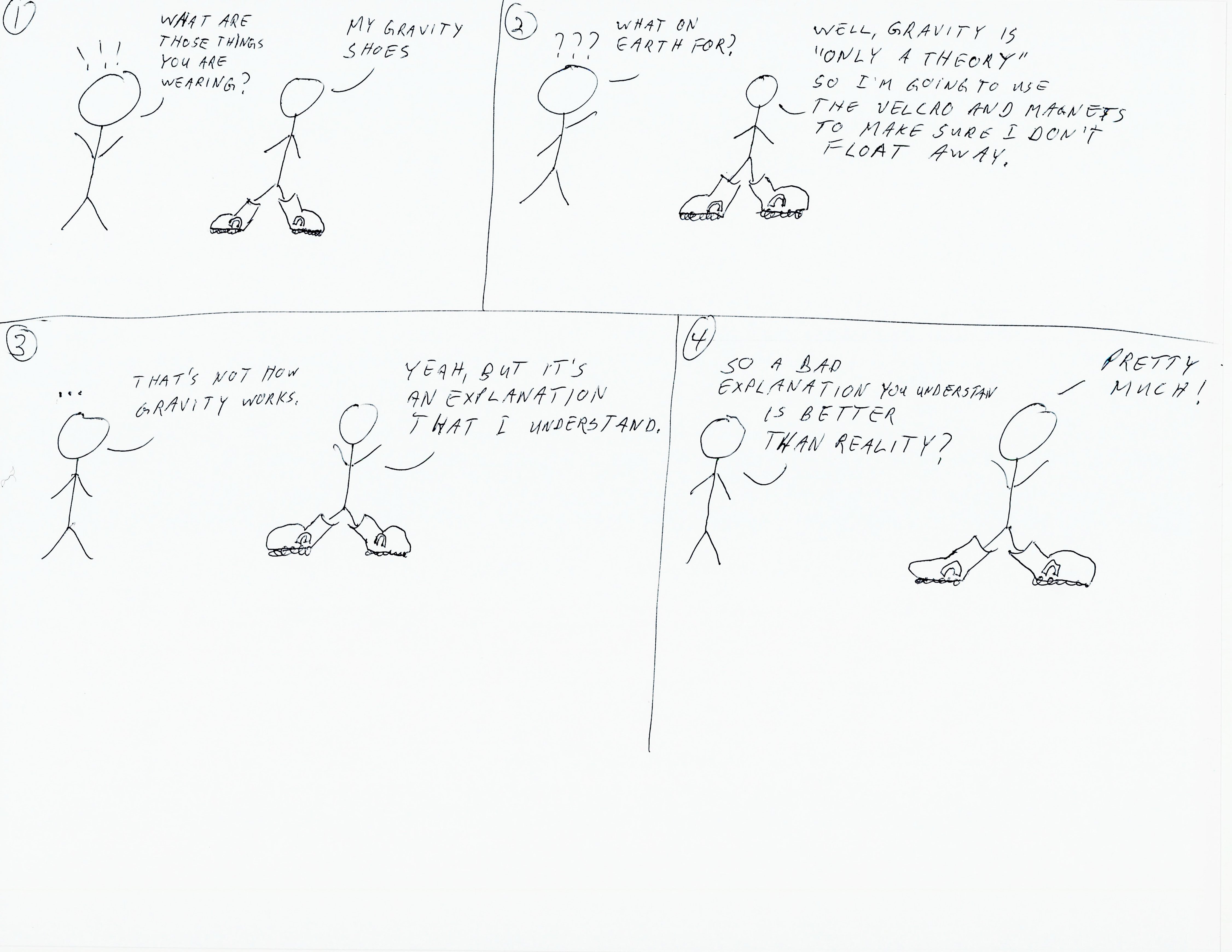
Intelligent falling is the latest rage! In a classic parody of the misuse of the word theory, The Onion cuts right to the jugular. Sort of along the vein of my entry to the FL Citizens for Science Stick Figure Cartoon contest. I know a lot of folks don't think that mockery is a good vehicle, but after a while you come to realize that some people are beyond reason, and instead of just killing them to remove them from the gene pool, mockery is the most gentle way of handling them.

Vaccines:
This video by Jenny McCarthy's close personal friends of Mumps, Measles, and Ruebella was also quite funny! I decided to spare my sanity, so I haven't read the comments there. Hopefully at least some of the deluded people will find their way here, and mayhap learn a thing or two.

And while not really a subject for this page in general, I got an uproarious laugh out of this Homeopathic ER skit. Is it just me, or do you have to be entirely daft not to see the sham for what it is?

And to those who may get their panties in a wad because we are being unkind and rightly mocking these loonies... Suck it up you pussies! Your stupidity deserves to be mocked. TARDS!

30 July 2009

So you think you can dance?

I was glad to see Evan make it through to the finals. I was sad to see Melissa go. She has grown the most as a dancer during this season. I think Kayla is destined to win, as is Brandon. So, what's your thoughts?

(Sorry this is such an abbreviated entry, I just spent a lot of time with the family, so you guys are the last thing I get to. It's just a facet of reality, no offense implied.)

29 July 2009

Atheists in Foxholes

I just got an email from the American Atheist magazine, and they would like to feature me in their "Atheists in Foxholes" segment. :) I though that was pretty cool. Okay, so I haven't actually been in an actual foxhole, but I have been shot at, and had my life in mortal danger numerous times, and not once, ever, did any sort of theistic thought enter my head. Heck, I can't think of the last time ever that anything close to theism contaminated my brain... I think it was when I was like 15 and trying to bang this hot "bible chick" and it was more a disguise of convenience. And when you think about it, it really seems to be that for the majority of believers. I just have the honesty to actually admit it!

Oh, and now that I have a good job offer, gotta get ready to put this house on the market. Since things have to move so fast, we'll be pricing this place to sell, so I'll be taking a beating on it... Oh well, I look at the long term gain here, over the short term loss. Something that folks on average are notoriously bag at judging. That and I think people get too caught up in security, and are too afraid to take chances. Well, except the chance to watch American Idol, rot their brain with religion, and get fat... But that's another rant I'm sure! ;)

Surprised at lack of News Coverage

Okay, so I saw a news story about YET ANOTHER senator being a total hypocrite and doing something that they publicly condemn, rail against and basically froth at the mouth saying is a BAD Thing. Yet I am surprised that I really haven't heard that much about it in the news. Is it become such a regular thing now that it's not even worth a section by Jeannie Moos? Here is what I heard over at Daniel Florien's blog:
State Sen. Paul Stanley is a good ol’ Republican boy. He teaches Sunday School at a United Methodist Church and is on their school board. He sponsored a bill to keep gay couples from adopting children. He’s quoted as saying that he “didn’t believe young people should have sex before marriage anyway, that his faith and church are important to him, and he wants to promote abstinence.” He’s married and has two children.

And now he’s admitted to having sex with his 22 year-old intern and taking nude photos of her.

How utterly shocking!

Okay, not really.

It came out when the intern’s boyfriend tried to blackmail the senator for $10,000.

He doesn’t want gay couples to adopt children because, in his bigotry, he sees them as depraved individuals who are not fit to raise children. The irony is his own religion condemns him — he committed adultery, which goes against one of his precious 10 Commandments. By his own standards, he’s not fit to raise children. It’s unlikely he would admit that, however. There’s nothing like hypocrisy to make fundies find excuses for what they normally denounce as heinous sins.

So no coverage? I mean, even Faux Noise can't run a story about this and "accidentally" put a (D) after this guys name like they did with Foley, and Craig, and Ensign, and whoever else they were afraid to give real reporting to since it reflected bad on their ideology. Too bad these morons and the C Street fucktardery is so rampant that it can't be hidden by these "mistakes". Not to say the D's are innocent. Hell, some of them are part of the C Street cult of fucktards... *YIKES* Although generally they aren't all up in arms about people's personal business and aren't trying to legislate it. Although, it seems that the Congresscritters are just another example of what happens with power. You'd think we would have learned with Rome.

Oh, did anyone catch The Daily Show?
The Daily Show With Jon StewartMon - Thurs 11p / 10c
Bill Kristol
www.thedailyshow.com
Daily Show
Full Episodes
Political HumorJoke of the Day

Yep, I have great health care, and none of you slobs deserve it, so suck it! Well, that seems to be the message from this douche bag. Amazing! So CAN the government run something good, or can't it? Make up your mind!

P.S. As for the actual agenda of a national healthcare plan... My view is that we need to get the insurance companies out of it. Incentiveize people to be healthier first of all, and then see what we can do to make the system efficient. Right now it's yet another bunch of douchebaggery that is out of control, and the government hasn't done a damn thing to stop it. Too much Laize Faire will result in abuses too... Because people are greedy douche bags!

And AGAIN the Republicans are being SUPREME douche bags... The only study they arte taking talking points from is the Lewin Group. They seem to be leaving out a KEY fact though:

The political battle over health-care reform is waged largely with numbers, and few number-crunchers have shaped the debate as much as the Lewin Group, a consulting firm whose research has been widely cited by opponents of a public insurance option.

To Rep. Eric Cantor of Virginia, the House Republican whip, it is "the nonpartisan Lewin Group." To Republicans on the House Ways and Means Committee, it is an "independent research firm." To Sen. Orrin Hatch of Utah, the second-ranking Republican on the pivotal Finance Committee, it is "well known as one of the most nonpartisan groups in the country."

Generally left unsaid amid all the citations is that the Lewin Group is wholly owned by UnitedHealth Group, one of the nation's largest insurers.

Oh Snap!

27 July 2009

RELIEF!

I was just told that a company that I interviewed for is putting together an offer. I should have it at the end of the week. This is one of the top paying folks I have interviewed with, and it's not contingent on them winning a contract and all that, so I am feeling a lot better about this. And with my drive and personality, I think I can do a lot of good at this company, and not be restricted and stymied by being in a government system. I am feeling a lot better now, and things are happy, happy for me!

So, now I get to goof off on the computer a little bit, and tonight I am going to pop that bottle of Dom I got in France back in 1996. Nom nom nom nom!

I did learn a lot during this whole process though! Some things that I never really considered before the whole process, as well as some things that really can't be taught in things like a TAP class. If anyone wants some additional help from someone who has gone through the process (and trust me, I met with some great success), feel free to drop me a line.

Okay, just keeping it short for today. Will still have to do a little typing (much later) over at Facts, not Fantasy anyway.

24 July 2009

Blog name in Urban Dictionary

Just for fun, I decided to check out a Google ranking of this blog using the name. Well, the first hit was an Urban Dictionary page, then the second hit was for a guy that's been blogging for quite a while longer than me, and then the third hit was for some sort of web hosting. Finally the fourth hit was this page.

I didn't expect much really, so as far as I am concerned, that's a pretty good Google ranking. The thing that cracked me up the most? Another word associated with blogiverse is blogistan. Okay, so I'm strange. I have already admitted that.

And, since I have been getting more traffic to this site, I figured I'd just post something else I found that was amusing. Not at all related to the original purpose of the blog, just some kerosene near a match. And this is someone else's writing, not mine. Just throwing this out.

Is Faith Good for Us?
Phil Zuckerman

Phil Zuckerman is an associate professor of sociology at Pitzer College in California. He is the author of Invitation to the Sociology of Religion (Routledge, 2003) and is currently writing a book on secularization in Scandinavia.

Whether Christian, Muslim, Jewish, or Sikh, there is one common belief that all religious fundamentalists share: worship of God and obedience to his laws are essential for a peaceful, healthy society. From Orthodox rabbis in the occupied West Bank to Wahhabi sheiks in Saudi Arabia, from the pope in Vatican City to Mormons in Salt Lake City, the lament is the same: God and his will must be at the center of everyone's lives in order to ensure a moral, prosperous, safe, collective existence.

Furthermore, fundamentalists agree that, when large numbers of people in a society reject God or fail to make him the center of their lives, societal disintegration is sure to follow. Every societal ill-whether crime, poverty, poor public education, or AIDS-is thus blamed on a lack of piety. A most disconcerting example of this worldview was expressed in the immediate aftermath of September 11, 2001, when Jerry Falwell blamed the terrorists attacks on America's "throwing God out of the public square," further adding that "when a nation deserts God and expels God from the culture . . . the result is not good."

If this often-touted religious theory were correct-that a turning away from God is at the root of all societal ills-then we would expect to find the least religious nations on earth to be bastions of crime, poverty, and disease and the most religious nations to be models of societal health. A comparison of highly irreligious countries with highly religious countries, however, reveals a very different state of affairs. In reality, the most secular countries-those with the highest proportion of atheists and agnostics-are among the most stable, peaceful, free, wealthy, and healthy societies. And the most religious nations-wherein worship of God is in abundance-are among the most unstable, violent, oppressive, poor, and destitute.

One must always be careful, of course, to distinguish between totalitarian nations where atheism is forced upon an unwilling population (such as in North Korea, China, Vietnam, and the former Soviet states) and open, democratic nations where atheism is freely chosen by a well-educated population (as in Sweden, the Netherlands, or Japan). The former nations' nonreligion, which can be described as "coercive atheism," is plagued by all that comes with totalitarianism: corruption, economic stagnation, censorship, depression, and the like. However, nearly every nation with high levels of "organic atheism" is a veritable model of societal health.

The twenty-five nations characterized by organic atheism with the highest proportion of nonbelievers are listed in Table 1. When looking at standard measures of societal health, we find that they fare remarkably well; highly religious nations fare rather poorly. The 2004 United Nations' Human Development Report, which ranks 177 countries on a "Human Development Index," measures such indicators of societal health as life expectancy, adult literacy, per-capita income, educational attainment, and so on. According to this report, the five top nations were Norway, Sweden, Australia, Canada, and the Netherlands. All had notably high degrees of organic atheism. Furthermore, of the top twenty-five nations, all but Ireland and the United States were top-ranking nonbelieving nations with some of the highest percentages of organic atheism on earth. Conversely, the bottom fifty countries of the "Human Development Index" lacked statistically significant levels of organic atheism.

Irreligious countries had the lowest infant-mortality rate (number of deaths per 1,000 live births), and religious countries had the highest rates. According to the 2004 CIA World Factbook (http://www.cia.gov/cia/publications/factbook), out of 225 nations, the twenty-five with the lowest infant-mortality rates had significantly high levels of organic atheism. Conversely, the seventy-five nations with the highest infant-mortality rates were all very religious and without statistically significant levels of organic atheism.

Concerning international poverty rates, the United Nations Report on the World Social Situation (2003) found that, of the forty poorest nations on earth (measured by the percentage of population that lives on less than one dollar a day), all but Vietnam were highly religious nations with statistically minimal or insignificant levels of atheism.

Regarding homicide rates, Oablo Fajnzylber et al., in a study reported in the Journal of Law and Economics (2002), looked at thirty-eight non-African nations and found that the ten with the highest homicide rates were highly religious, with minimal or statistically insignificant levels of organic atheism. Conversely, of the ten nations with the lowest homicide rates, all but Ireland were secular nations with high levels of atheism. James Fox and Jack Levin, in The Will to Kill, looked at thirty-seven non-African nations and found that, of the ten nations with the highest homicide rates, all but Estonia and Taiwan were highly religious, with statistically insignificant levels of organic atheism. Conversely, of the ten nations with the lowest homicide rates, all but Ireland and Kuwait were relatively secular nations, with high levels of organic atheism.

Concerning literacy rates, according to the United Nations Report on the World Social Situation (2003), of the thirty-five nations with the highest levels of youth-illiteracy rates (percentage of population ages fifteen to twenty-four who cannot read or write), all were highly religious, with statistically insignificant levels of organic atheism.

In regard to rates of AIDS and HIV infection, the most religious nations on earth-particularly those in Africa-fared the worst. (Botswana suffers from the highest rate of HIV infection in the world; see http://www.avert.org/aroundworld. htm.) Conversely, the highly irreligious nations of Western Europe, such as those of Scandinavia-where public sex education is supported and birth control is widely accessible-fared the best, experiencing among the lowest rates of AIDS and HIV infection in the world.

Concerning gender equality, nations marked by high degrees of organic atheism are among the most egalitarian in the world, while highly religious nations are among the most oppressive. According to the 2004 Human Development Report's "Gender Empowerment Measure," the ten nations with the highest degrees of gender equality were all strongly organic-atheistic nations with significantly high percentages of nonbelief. Conversely, the bottom ten were all highly religious nations without any statistically significant percentages of atheists. According to Ronald Inglehart and Pippa Norris's (2003) "Gender Equality Scale," of the ten nations most accepting of gender equality, all but the United States and Colombia were marked by high levels of organic atheism; of the ten least-accepting of gender equality, all were highly religious and had statistically insignificant levels of organic atheism. According to Inglehart et al. in Human Values and Social Change (2003), countries such as Sweden, Denmark, and the Netherlands, with the most female members of parliament, tended to be characterized by high degrees of organic atheism, and countries such as Pakistan, Nigeria, and Iran, with the fewest female members in parliament, tended to be highly religious.

The acceptance of gender equality among irreligious nations may be linked to the relative acceptance of homosexuality. Inglehart et al., in Human Beliefs and Values: A Cross-Cultural Sourcebook Based on the 1999-2002 Value Surveys (2004), found that, of the eighteen nations least likely to condemn homosexuality, all were highly ranked organic-atheistic nations. Conversely, of the eighteen nations most likely to condemn homosexuality, all but Hungary were highly religious, with statistically insignificant levels of organic atheism.

A country's suicide rate stands out as the one indicator of societal health in which religious nations fare much better than secular nations. According to the 2003 World Health Organization's report on international male suicide rates (http://www.who.int/en/), the nations with the lowest rates of suicide were all highly religious, characterized by extremely high levels of theism (usually of the Muslim and Catholic varieties). Of the ten nations with the highest male suicide rates, five were distinctly irreligious nations ranked among the top twenty-five nations listed earlier. These five are Estonia, Hungary, Latvia, Russia, and Slovenia. It is interesting to note that of the nations currently experiencing the highest rates of suicide-including the five just mentioned-nearly all are former Soviet/communist-dominated societies. (The nations of Scandinavia, where organic atheism is strongest, do not have the highest suicide rates in the world, as is widely thought to be the case.)

In sum, countries with high rates of organic atheism are among the most societally healthy on earth, while societies with nonexistent rates of organic atheism are among the most destitute. The former nations have among the lowest homicide rates, infant mortality rates, poverty rates, and illiteracy rates and among the highest levels of wealth, life expectancy, educational attainment, and gender equality in the world. The sole indicator of societal health in which religious countries scored higher than irreligious countries is suicide.

Where does the United States fit in all this? Americans are very religious. Many studies have found that only between 3-7 percent of Americans do not believe in God. Rates of prayer, belief in the divinity of Jesus, belief in the divine origins of the Bible, and rates of church attendance are remarkably robust in the United States, making it the most religious of all Western industrialized nations, with the possible exception of Ireland. When it comes to societal health, the United States certainly fares far better than much of the rest of the world. According to the United Nations' 2004 "Human Development Index" discussed earlier, the United States ranked eighth. However, when we compare the United States to its peer nations-i.e., developed, industrialized, democratic nations such as Canada, Japan, and the nations of Europe-its standing in terms of societal health plummets. The United States has far higher homicide, poverty, obesity, and homelessness rates than any of its more secular peer nations. It is also the only Western industrialized democracy that is unwilling to provide universal health coverage to its citizens. The fact is that extremely secular nations such as Japan and Sweden are much safer, cleaner, healthier, better educated, and more humane when compared to the United States, despite the latter's exceptionally strong levels of theism.

The information presented in this discussion in no way proves that high levels of organic atheism cause societal health or that low levels of organic atheism cause societal ills such as poverty or illiteracy. The wealth, poverty, well-being, and suffering in various nations are caused by numerous political, historical, economic, and sociological factors that are far more determinant than people's personal belief systems. Rather, the conclusion to be drawn from the data provided above is simply that high levels of irreligion do not automatically result in a breakdown of civilization, a rise in immoral behavior, or in "sick societies." Quite the opposite seems to be the case. Furthermore, religion is clearly not the simple and single path to righteous societies that religious fundamentalists seem to think it is. This fact must be vigorously asserted in response to the proclamations of politically active theists. From small-town school boards to the floor of the Senate, conservative Christians are championing religion as the solution to America's societal problems. However, their pious "solution" is highly dubious and clearly not supported by the best available research of social science.

Belief in God may provide comfort to the individual believer, but, at the societal level, its results do not compare at all favorably with that of the more secular societies. When seeking a more civil, just, safe, humane, and healthy society, one is more likely to find it among those nations ranking low in religious faith-contrary to the preaching of religious folks.

Further Reading
Reginald Bibby, Restless Gods: The Renaissance of Religion in Canada (Toronto, Ontario, Canada: Stoddart Publishing Company, 2002).
Grace Davie, "Europe: The Exception That Proves the Rule?" in The Desecularization of the World, edited by Peter Berger (Grand Rapids, Mich.:William B. Eerdmans Publishing Company, 1999).
Kim Eungi, "Religion in Contemporary Korea: Change and Continuity," Korea Focus, July-August 2003.
Oablo Fajnzylber, Daniel Lederman, and Norman Loatza, "Inequality and Violent Crime," The Journal of Law and Economics, April 2002.
James Fox and Jack Levin, The Will to Kill (Boston, Mass.: Allyn and Bacon, 2000).
Timothy Gall, Worldmark Encyclopedia of Culture and Daily Life, Vol.4: Europe (Cleveland, Ohio: Eastword Publications. 1998).
George Gallup and Michael Lindsay, Surveying the Religious Landscape (Harrisburg, Pa.: Morehouse Publishing, 1999).
Andrew Greeley, Religion in Europe at the End of the Second Millennium (New Brunswick, N.J.: Transaction Publishers, 2003).
Goran Gustafsson and Thorleif Pettersson, Folkkyrk och religios pluraism-den nordiska religiosa modellen (Stockholm: Verbum Forlag, 2000).
Michael Hout and Claude Fischer, "Why More Americans Have No Religious Preference: Politics and Generations," American Sociological Review 67, no. 2 (2002).
Ronald Inglehart, Miguel Basanez, Jaime Diez-Medrano, Loek Halman, and Ruud Luijkx, Human Beliefs and Values: A Cross-Cultural Sourcebook Based on the 1999-2002 Value Surveys, (Beunos Aires, Argentina: Siglo Veintiuno Editores, 2004).
Ronald Inglehart and Pippa Norris, Rising Tide: Gender Equality and Cultural Change Around the World (New York: Cambridge University Press, 2003).
Ronald Inglehart, Pippa Norris, and Christian Welzel, "Gender Equality and Democracy," in Human Values and Social Change, edited by Ronald Inglehart (Boston, Mass.: Brill, 2003).
Peri Kedem, "Dimensions of Jewish Religiosity," in Israeli Judaism, edited by Shlomo Deshen, Charles Liebman, and Mishe Shokeid (London: Transaction Publishers, 1995).
Gerald Marwell and N.J. Demerath, "'Secularization' by Any Other Name," American Sociological Review 68, no. 2 (2003).
Pippa Norris and Ronald Inglehart, Sacred and Secular: Religion and Politics Worldwide (New York: Cambridge University Press, 2004).
Gregory Paul, "The Secular Revolution of the West: It's Passed America By-So Far," Free Inquiry 22, no. 3 (Summer 2002).
--, "Cross National Correllations of Quantifiable Societal Health with Popular Religiosity and Secularism in the Prosperous Democracies," Journal of Religion and Society, vol. 7 (2005).
Detlef Pollack, "The Change in Religion and Church in Eastern Germany after 1989: A Research Note," Sociology of Religion 63, no. 3 (2002).
United Nations, Human Development Report (New York: Oxford University Press, 2004).
United Nations, Report on the World Social Situation (New York: United Nations Publications, 2003).

Atheist Bilboard: Predict xtian reaction!

And to think, I live south of these folks, and I bet that the locals in this area would get even more irate! And is so fucking predictable! I love the way the author of this particular blog starts off with a parody of the situation. Anyway, here is the write up. Oh, the amusement and irony!

Atheist Billboard Outrages Alabama Christians


Once again, loving Christians are demonstrating just how much more tolerant and respectful they than the militant atheists in their midst. Atheists in Alabama have erected a billboard declaring religion to be the cause for all evils and demanding that it be stamped out while religious believers, despite disagreeing with and objecting to the message, are firmly defending the rights of atheists to express their views just like all other citizens.

No, I'm just kidding — atheists merely put out the mild idea of imagining the absence of religion and Christians are howling with outrage. One company refused to rent them billboard space and, after finding a place for their sign, the atheists are receiving lots of complaints. This is pretty much how it always goes: atheists express something fairly mild and innocuous and Christians throw a fit.

23 July 2009

The Psychology of Cranks

I just had a friend point me to a write up that had me rolling. Thank you IVAN3MAN for making my evening particularly entertaining. And I thought that I would share the write up. Why? Well, the psychology of cranks can be applied to a lot of irrational beliefs us humans have. As a matter of fact, us humans really suck at decision making unless we are made aware of the pitfalls of our own brains. As discussed in this article linked from Scientific American. But I think it applies well on matters that have enslaved human minds for millennium (i.e. religion). Of course, to point out to the deluded and misinformed only makes them more secure,because being wrong is somehow an admission to fallibility that is beyond them. I am reminded of a study, where people who rate themselves at the extreme height of competence in a field, are generally rated very lowly by their peers. People are blind to their own weaknesses and failings. Sure, there is something to be said for confidence, but when you hold on to confidence blindly, you start stepping into the territory of delusion.

Anyway, here is the article on "Crankery". It's amazing how well this applies to so many individuals out there.

The psychology of crankery

Category: ConspiraciesCranks
Posted on: June 8, 2009 6:24 AM, by MarkH

ResearchBlogging.orgOur recent discussions of HIV/AIDS denial and in particular Seth Kalichman's book "Denying AIDS" has got me thinking more about the psychology of those who are susceptible to pseudoscientific belief. It's an interesting topic, and Kalichman studies it briefly in his book mentioning the "suspicious minds":

At its very core, denialism is deeply embedded in a sense of mistrust. Most obviously, we see suspicion in denialist conspiracy theories. Most conspiracy theories grow out of suspicions about corruptions in government, industry, science, and medicine, all working together in some grand sinister plot. Psychologically, suspicion is the central feature of paranoid personality, and it is not overreaching to say that some denialists demonstrate this extreme. Suspicious thinking can be understood as a filter through which the world is interpreted, where attention is driven towards those ideas and isolated anecdotes that confirm one's preconceived notions of wrong doing. Suspicious thinkers are predisposed to see themselves as special or to hold some special knowledge. Psychotherapist David Shpairo in his classic book Neurotic Styles describes the suspicious thinker. Just as wee see in denialism, suspiciousness is not easily penetrated by facts or evidence that counter individuals' preconceived worldview. Just as Shapiro describes in the suspicious personality, the denialist selectively attends to information that bolsters his or her own beliefs. Denialists exhibit suspicious thinking when they manipulate objective reality to fit within their beliefs. It is true that all people are prone to fit the world into their sense of reality, but the suspicious person distorts reality and does so with an uncommon rigidity. The parallel between the suspicious personality style and denialism is really quite compelling. As described by Shapiro:

A suspicious person is a person who has something on his mind. He looks at the world with fixed and preoccupying expectation, and he searches repetitively, and only, for confirmation of it. He will not be persuaded to abandon his suspicion of some plan of action based on it. On the contrary, he will pay no attention to rational arguments except to find in them some aspect or feature that actually confirms his original view. Anyone who tries to influence or persuade a suspicious person will not only fail, but also, unless he is sensible enough to abandon his efforts early will, himself, become an object of the original suspicious idea.

The rhetoric of denialism clearly reveals a deeply suspicious character. In denialism, the science of AIDS is deconstructed to examine evidence taken out of context by non-scientists. The evidence is assimilated into one's beliefs that HIV does not cause AIDS, that HIV tests are invalid, that the science is corrupt, and aimed to profit Big Pharma.
...
The insights offered by Shapiro are that denialists are not "lying" in the way that most anti-denialists portray them. The cognitive style of the denialist represents a warped sense of reality for sure, explaining why arguing or debating with a denialist gets you nowhere. But the denialist is not the evil plotter they are often portrayed as. Rather denialists are trapped in their denialism.
...
Psychologically, certain people seem predisposed to suspicious thinking and it seems this may be true of denialism as well. I submit that dienialism stems from a conspiracy-theory-prone personality style. We see this in people who appear predisposed to suspiciousness, and these people are vulnerable to anti-establishment propaganda. We know that suspicious people view themselves as the target of wrongdoing and hold persecutory ideas.

I agree that this certainly represents a portion of denialists, but not all. I think others, for example creationists and global warming denialists, tend to have a different motivation and style, due to ideological extremism that warps their worldview. Ideological and paranoid denialism can co-exist within denialist camps, or even within an individual, but there are areas where the overlap is incomplete. Still, the issue of the suspicious personality style is important.

We all know this person. If you don't, maybe you know Dale Gribble (AKA Rusty Shackleford).

Rusty Shackleford
I just know Mike Judge has met the suspicious personality style and encapsulated the extreme of this personality in this character. Dale inevitably sees every event as tied to some bizarre government/alien conspiracy, and inevitably the other men in the alley ignore his interjections or Hank simply says, "that's asinine". Hank is a wise man. To argue with a Dale would only make you look like the fool.

Some anti-denialists sites have recently brought to my attention a growing body of work trying to understand how people become conspiracy theorists. Two papers in particular are of interest, the first Unanswered Questions: A Preliminary Investigation of
Personality and Individual Difference Predictors of 9/11 Conspiracist Beliefs
[1] is an interesting study because it provides some explanation for crank magnetism.


So, how was this study done and what did this study show?

For one, I enjoyed reading this study because, as with all well-written papers, they had a nice introduction into the literature behind the psychology of belief in conspiracy theories. This is something I'm becoming more familiar with, but feel that it's also a relatively crude approximation of what is happening. There are several hypotheses about what causes conspiratorial beliefs, and they cite a number of previous studies that attempt to explain the phenomenon. These explanations range from feelings of political powerlessness feeding into conspiracism, to cultural or group understanding of events, to psychological explanations like the need to preserve self-esteem, express feelings like anger at disliked groups, or be individualistic, and some hypotheses which focus on specific deficiencies in cognition.

It's a small study (n=257) of British men and women who were given surveys to analyze their "Support for Democratic Principles", an inventory to assess their belief in conspiracy theories (15 items allowing them to show relative support for common conspiracy theories - with the exception they had to drop the question about Elvis being alive since it was too far out even for conspiracy theorists), a "big five" questionnaire (which assess the five personality factors of openness, conscientiousness, extraversion, agreeableness and neuroticism), a "9/11 conspiracist beliefs scale", a inventory assessing feelings about authority, one for cynicism, and one for exposure to 9/11 conspiracy beliefs.

The researchers then took the data from these surveys, loaded them into matrices and then tried to fit it to various models to create significant linkages between 9/11 beliefs and various personality factors. This is not research in which I have any expertise, so if anyone would like to provide any criticisms of how they did it that may impact results I'd be happy to hear it. I am trusting the peer-reviewers in this case to have done a good job vetting their technique for obvious flaws.

What did they find?

Well, in general 9/11 conspiracy beliefs were low prevalence, but interestingly they felt 9/11 conspiracy beliefs could be predicted from a few personality indicators, and, consistent with crank magnetism, belief in 9/11 conspiracies was part of a general conspiratorial attitude with belief in multiple conspiracy theories being common according to their general conspiracism scale. The authors explain their findings thusly:


The results of this preliminary examination of 9/11 conspiracist theories can be predicted by a number of personality and individual difference variables, which together explained just over half of the variance in the former. As shown in Figure 1, General Conspiracist Beliefs had the strongest effect on 9/11 Conspiracist Beliefs, which not surprisingly was also affected by 9/11 Conspiracist Exposure. Of the more distal predictors, only Political Cynicism, Attitudes to Authority and Agreeableness had significant effects on 9/11 Conspiracist Beliefs when the less distal predictors were taken into account; however, there were several significant effects of the more distal on the less distal predictors, namely Attitudes to Authority and Openness on 9/11 Conspiracist Exposure, and Political Cynicism, Support for Democratic Principles and Openness on General Conspiracist Beliefs. Age and sex differences were found for Agreeableness and Support for Democratic Principles, though age also affected 9/11 Conspiracist Exposure when the more distal mediators were taken into account.
The finding that exposure to 9/11 conspiracist ideas was positively associated with holding 9/11 conspiracy beliefs is perhaps not surprising. It seems likely that coming into contact with such ideas (either directly or indirectly) increases an individual's understanding and, consequently, acceptance of such ideas (alternatively, it is also possible that individuals who already believe in 9/11 conspiracy theories seek out such information). More interesting was the finding that General Conspiracist Beliefs was positively associated with 9/11 conspiracist ideas, a result that fits with Goertzel's (1994) assertion that conspiracy beliefs form part of a monological belief system, in which each conspiratorial idea serves as evidence for other conspiratorial beliefs. For example, believing that John F. Kennedy was not killed by a lone gunman, or that the Apollo moon landings were staged, increases the chances that an individual will also believe in 9/11 conspiracy theories. As Goertzel (1994) highlights, monological belief systems provide accessible explanations for new phenomena that are difficult to comprehend or that threaten existing belief systems (Goertzel, 1994).
Moreover, Goertzel (1994) points out that, often, the proof offered as evidence for a conspiracy is not specific to one incident or issue, but is used to justify the general pattern. That a government is covering-up its involvement in the 9/11 attacks, for instance, goes to show that it is also covering-up the fact that extraterrestrial life has visited Earth, or that national governments are involved in political assassination. Thus, the more conspiracy theories a monological thinker agrees with, the more she or he will accept and assimilate any new conspiracy theory that is proposed.

I'm going to have to read some more by this Goertzel cat. This is an interesting study though because it correlates these two behaviors that we ourselves have observed so frequently. It is limited by size, and that it was done on British subjects, but somehow I suspect it isn't unfair to generalize from British cranks to American ones or cranks worldwide. I would like to see their findings replicated on a larger scale, as even though their findings were significant, they were looking at a small subset of a relatively small number of subjects.

The second paper I'd like to talk about Paranormal Belief and Susceptibility to the Conjunction Fallacy[2], approaches a similar problem from the point of view that maybe people who believe in such obvious nonsense have difficulties with basic reasoning skills.

These authors begin with a discussion of a more developed literature that describes the common cognitive deficits encountered in people who believe in the paranormal. Basically, what has been found, again and again, is that people who believe in paranormal events have certain cognitive deficits and in particular have problems with probabilistic reasoning.

It is widely recognised that most people are poor at judging probability and that under conditions of uncertainty, will rely on heuristics--cognitive 'rules of thumb'--to simplify the reasoning process so as to make quick, easy and proximate, but ultimately flawed, judgments (e.g. Gilovich, Griffin, & Kahneman, 2002; Kahneman, Slovic, & Tversky, 1982; Shaifi, 2004; Sutherland, 1992). Further research suggests a person's pre-existing or a priori beliefs can have a significant influence on these heuristical judgements (e.g. Watt, 1990/1991). Blackmore and Troscianko (1985) were first to test whether paranormal believers were especially prone to probabilistic reasoning biases. They had paranormal believers and non-believers answer questions relating to the generation of random strings (i.e. list 20 numbers as if drawn from a hat), randomness judging (i.e. indicate whether various boy/girl mixes were biased or unbiased), coin tossing outcomes (i.e. indicate whether the number of heads scored from 20 throws was biased or unbiased) and sampling decisions (e.g. indicate which is more likely to be drawn from a given number of red and blue sweets). Whilst no group differences were found for the random string generation or randomness judging tasks, Blackmore and Troscianko found that those who believed in the possibility of extrasensory perception1 made more coin tossing and sampling errors than non-believers. These data suggest paranormal believers underestimate the likelihood of a chance outcome and 'look beyond' coincidence in search of causal--usually supernatural-- explanations. According to Blackmore and Troscianko (1985), this underestimating of chance expectations--termed the 'chance baseline shift'--may strengthen one's belief in psi even when there is no evidence that psi actually exists. Subsequent work examining believers' tendency to misunderstand chance offers mixed results. Henry (1993) found most people believe intuition (71%) and psi (64%) are the best explanations for 'everyday coincidence experiences' (see also Henry, 2005) whilst Bressan (2002; Study 1) found paranormal believers reported having more frequent 'meaningful coincidences' than non-believers. Likewise, Tobacyk and Wilkinson (1991) found those with a more pronounced belief in the paranormal (specifically, in superstition, psi and precognition) had a higher preference for games of chance and were more prone to developing illusory correlations between statistically unrelated events (see also Vyse, 1997). Marks (2002) goes further by suggesting believers misperceive chance events as somehow being related because their a priori beliefs in the paranormal demand such a relationship and thus, that they are especially prone to making 'subjective validations'.

It's an interesting discussion, as many of the findings seem to be subject to general cognitive ability, and there have been mixed results in identifying the "believers" specific problems with understanding randomness and probability. There's a saying in medicine, the questions stay the same, it's just the answers that change. Well, the question remains, why do believers in paranormal events impute more significance to random events than non-believers?

These authors are interested in studying the problem from the point of view that the heuristics, or cognitive rules of thumb that people use to make decisions, in believers are off with regards to the conjunction fallacy. This refers to a tendency, that is very common overall, to ascribe a higher probability of an event occurring if it is associated in the individuals mind with another event, even if the probabilities of the two events are independent.

Conjunction biases have been demonstrated in a wide variety of hypothetical contexts where, in most cases, the proportion of individuals violating the conjunction rule ranges from between 50 and 90% (Fisk, 2004; Tversky & Kahneman, 1983). Given previous claims that paranormal believers' susceptibly to reasoning biases may be context or domain specific (e.g. Gray & Mills, 1990; Merla-Ramos, 2000; Wierzbicki, 1985; although see Lawrence & Peters, 2004; Roe, 1999), it seems reasonable to expect believers will be more prone to the conjunction fallacy, particularly when conjunctive events appear to reflect paranormal phenomena. Take the common example of when one is thinking about an old friend just at the moment he/she unexpectedly calls (e.g. Rhine-Feather & Schmicker, 2005). Here, the two constituent events--namely (a) thinking about the friend and (b) that friend unexpectedly calling--may not be unusual in their own right. One may have thought about the same friend many times before or alternatively, many other friends may have unexpectedly called in the past; neither would be particularly surprising (cf. Fisk, 2004). It is only when these two constituent events co-occur in close temporal proximity that this conjunction is deemed too unlikely to be a simple coincidence. In such cases, many experients will dismiss chance and look for a causal, often paranormal, explanation (cf. Blackmore & Troscianko, 1985; Bressan, 2002; Marks, 2002). Similar logic can be applied to other aspects of the paranormal including the apparent accuracy of psychic predictions where the co-occurrence of two constituent events--namely (a) the prediction and (b) the predicted outcome--seems too unlikely to be just a coincidence. Given previous claims that paranormal believers often misunderstand chance and randomness (e.g. Bressan, 2002), it seems reasonable to suggest believers may be especially prone to the conjunction fallacy. Evidence that believers tend to adopt an intuitive (heuristical) as opposed to an analytic thinking style (Aarnio & Lindeman, 2005; Irwin & Young, 2002; Lester, Thinschimdt, & Trautman, 1987), which in turn is associated with more conjunction errors (Fisk, 2004; Toyosawa & Karasawa, 2004), adds further support to this assertion. Moreover, given that personal experience of alleged paranormal phenomena is the single biggest predictor of paranormal belief (Blackmore, 1984), a tendency to misjudge conjunctive events as having some underlying causal relationship may help explain the maintenance, and perhaps even the development, of such beliefs

So, what did they do? They constructed a series of vignettes that test people's tendency to fall for the conjunction fallacy, and then simultaneously tested them for the presence or absence of paranormal beliefs. Importantly, in addition to testing for paranormal beliefs, the researchers controlled for achievement in psychology, statistics, and mathematics.

They found their hypothesis was correct. The relatively common conjunction bias was even more common in those who believed in paranormal phenomena. Problems with the study again included small size and worse, this was performed on a relatively homogeneous population of college students in England.

So what do these studies mean for our understanding of cranks? Well, in addition to providing explanations for crank magnetism, and cognitive deficits we see daily in our comments from cranks, it suggests the possibility that crankery and denialism may be preventable by better explanation of statistics. Much of what we're dealing with is likely the development of shoddy intellectual shortcuts, and teaching people to avoid these shortcuts might go a long way towards the development and fixation on absurd conspiracy theories or paranormal beliefs.

Viren Swami, Tomas Chamorro-Premuzic, Adrian Furnham (2009). Unanswered questions: A preliminary investigation of personality and individual difference predictors of 9/11 conspiracist beliefs Applied Cognitive Psychology DOI: 10.1002/acp.1583

Rogers, P., Davis, T., & Fisk, J. (2009). Paranormal belief and susceptibility to the conjunction fallacy Applied Cognitive Psychology, 23 (4), 524-542 DOI: 10.1002/acp.1472