My Actual Homepage - Go here for more info.


I plan to put a graphical banner here eventually...
Showing posts with label secularism. Show all posts

29 January 2011

Thomas Paine: Age of Reason

So a discussion happened about Thomas Paine.  For those who went to school in Texas (or any other fundy dominated part of the US), Thomas Paine is considered a "Founding Father" and a pretty smart guy.  He wrote many works that were considered the bedrock upon which this country was founded on.  One book he wrote was called Common Sense, which could serve as a warning to our modern political system. Common Sense is worth a glance, if anyone is interested. Although it isn't as heavily focused on religion as Age of Reason, it has a few gems.
It is of the utmost danger to society to make it (religion) a party in political disputes.
Mingling religion with politics may be disavowed and reprobated by every inhabitant of America.
Anyway, Age of Reason should be part of everyone's library, especially as a counter to the "US is a Christian Nation" drivel that people seem to want to go on about here in the Theitard States of Amrika.  Thankfully, it should be easy for anyone to get their hands on this book now.  It is part of the most excellent Gutenberg Project.

From the Age of Reason Wikipedia page:
The Age of Reason; Being an Investigation of True and Fabulous Theology is a deistic pamphlet, written by eighteenth-century British radical and American revolutionary Thomas Paine, that criticizes institutionalized religion and challenges the legitimacy of the Bible, the central sacred text of Christianity. Published in three parts in 1794, 1795, and 1807, it was a bestseller in the United States, where it caused a short-lived deistic revival. British audiences, however, fearing increased political radicalism as a result of the French Revolution, received it with more hostility. The Age of Reason presents common deistic arguments; for example, it highlights what Paine saw as corruption of the Christian Church and criticizes its efforts to acquire political power. Paine advocates reason in the place of revelation, leading him to reject miracles and to view the Bible as an ordinary piece of literature rather than as a divinely inspired text. It promotes natural religion and argues for the existence of a creator-God.

Most of Paine's arguments had long been available to the educated elite, but by presenting them in an engaging and irreverent style, he made deism appealing and accessible to a mass audience. The book was also inexpensive, putting it within the reach of a large number of buyers. Fearing the spread of what they viewed as potentially revolutionary ideas, the British government prosecuted printers and booksellers who tried to publish and distribute it. Paine nevertheless inspired and guided many British freethinkers of the nineteenth and twentieth centuries and his influence and spirit endures in the works of contemporary writers like Christopher Hitchens.

So, while Paine's above-described work was deistic, and presented various arguments purportedly in favour of a supernatural entity, it apparently contains a wholesale rejection of all the ideas expounded by religious fundamentalists today, such as the assertion that the United States was founded as a "Christian nation", the assertion that the Bible is "inerrant", and numerous others.

For those who want to access this work, not least in order to slap down fundies who assert that the United States was purportedly founded as a "Christian nation", the relevant Gutenberg Project link is this one.

And it would seem Bill Maher agrees:

27 January 2011

About.com: Scientific Links Between Homophobia and Repressed Homosexuality

All I can say is that this is in the "no surprise" category.  And having actual data back up an opinion is always nice.  I do wonder, what would a study reveal about straights who support gay rights?  My guess would be that there would be nothing statistically significant to be culled from that data (except perhaps a humanist viewpoint).  It always bothers me that the raging against homosexuals uses the same rhetoric as the raging against interracial marriages, or against civil rights for African-Americans (or any other minority for that matter).  It's like these bigots haven't thought of a new argument during the entire history of human rights struggles...  Oh yea, they haven't!

Anyway, enjoy the article.  I found it sort of funny in a sad kind of way.

Scientific Links Between Homophobia and Repressed Homosexuality

It often said that people who are loudest in their condemnations of homosexuality are probably hiding their own homosexuality. Anecdotes aren't data, however, so no manner how many homophobic bigots come out of the closet that wouldn't prove that there is a link between homophobia and repressed homosexuality.

Fortunately, we do have data -- real scientific data. There have been scientific studies which reveal strong links between being homophobic and harboring repressed homosexual urges or desires. This doesn't mean that every homophobic bigot is trying to repressed their own homosexuality, but it does make it a legitimate possibility and might be more common than is currently believed.
One of the most important lines of work in this area dates back to a 1996 article published in The Journal of Abnormal Psychology. In this empirical paper, researchers Henry Adams, Lester Wright, Jr., and Bethany Lohr from the University of Georgia report evidence that homophobic young males may secretly have gay urges.

In this study, 64 self-reported straight males with a mean age of 20.3 years were divided into two groups ("non-homophobic men" and "homophobic men") on the basis of their scores on a questionnaire measure of aversion to gay males. Here, homophobia was operationally defined as the degree of "dread" experienced when placed in close quarters with a homosexual--basically, how comfortable or uncomfortable the person was in interacting with gay people. (There is debate in the clinical literature about the semantics of this term, with some scholars introducing other constructs such as "homonegativism" to underscore the more cognitive nature of some people's antigay stance.)

Each participant then agreed to attach a penile plethysmograph to his, well, "lesser self." According to the authors, this plethysmograph device is "a mercury-in-rubber circumferential strain gauge used to measure erectile responses to sexual stimuli. When attached, changes in the circumference of the penis cause changes in the electrical resistance of the mercury column." Previous research with this apparatus (the plethsymograph, not the penis--well, actually both) confirmed that significant changes in circumference occur only during sexual stimulation and sleep.

Next, the participants were placed in a private chamber and presented with three 4-minute segments of graphic pornography. The three video snippets represented straight porn (scenes of fellatio and vaginal intercourse), lesbian porn (scenes of cunnilingus or tribadism), and gay male porn (scenes of fellatio and anal intercourse). Following each randomly ordered video presentation, the participant rated how sexually aroused he felt and also his degree of penile erection. Can you guess the results?

Both groups--non-homophobic and homophobic men--showed significant engorgement to the straight and lesbian porn and their subjective ratings of arousal matched their penile plethsymograph measure for these two types of video. However, as predicted, only the homophobic men showed a significant increase in penile circumference in response to the gay male porn: specifically, 26 percent of these homophobic men showed "moderate tumescence" (6-12 mm) to this video and 54 percent showed "definite tumescence" (more than 12 mm). (In contrast, for the non-homophobic men, these percentages were 10 and 24, respectively.) Furthermore, the homophobic men significantly underestimated their degree of sexual arousal to the gay male porn.

Source: Scientific American
There have been some attempts at alternative explanations for this data but the author is able to argue that they aren't very convincing. It's hard to find fault in the reasoning here: if you find something attractive which you also believe is evil or disgusting, then not only will you repress it but you'll act to eliminate it from view. You can't be tempted by something you both love and hate if you can't see or hear it anymore.

This connection between homophobia and violence is extremely disturbing. Being homophobic isn't just linked to repressed homosexual desires, it's also linked to an increased willingness to use violence against people for no other reason than that they are gay:
Some of the most startling data I've come across lately involve a 1998 survey of 500 straight males in the San Francisco, California area. Half of these men said they had acted aggressively in some way against homosexuals (and these were just the ones who admitted to such acts). And a third of those who hadn't struck out in this manner against gay people said that they would assault or harass a "homosexual who made a pass at them." If you missed the irony, this was in San Francisco--arguably one of the most "gay-friendly" places in the world!
In one experiment described by the author, homophobic men delivered electrical shocks of greater intensity and longer duration when they thought the victim was a gay man than when they thought it was a straight man -- and this was simply "punishment" for answering a question wrong. The homophobic men essentially lashed out against gay men they didn't know and had no connection to. The fact that they were gay was the sole reason for hurting them.

05 December 2010

2010 War on christMyth from CNN

Sorry that this dispatch on the war against christMyth is almost a month late in getting posted from when it was posted at CNN.  Hey, I can't keep track of all that is going on everywhere.  And let's face it, I am not the only one at this.  Just having fun anyway.  I guess this isn't so much directed at the myth of the winter solstice, but the whole book itself.  And remember, "The God of the Old Testament is arguably the most unpleasant character in all fiction: jealous and proud of it; a petty, unjust, unforgiving control-freak; a vindictive, bloodthirsty ethnic cleanser; a misogynistic, homophobic, racist, infanticidal, genocidal, filicidal, pestilential, megalomaniacal, sadomasochistic, capriciously malevolent bully."  I for one applaud the ad campaign.


The new humanist campaign cites holy books

The Bible and the Quran contain "horrific material, and to say  you get your morality from there" is a problem, the head of the American Humanist Association said Tuesday as the group launches what it calls the  largest, most extensive advertising campaign ever by a godless organization.

The group is putting ads in newspapers across the country - and  advertising on NBC - in the $200,000 campaign, AHA head Roy Speckhardt told  CNN.

The point, he said, it to "challenge the fundamentalists" who "spout  their backward ideas," he said.
The target audience is people who may not realize they are humanists,  Speckhardt explained.


"We're targeting for criticism those who read the Bible literally, not those who pick and choose what they like," he said. "We're telling (people who  pick and choose), 'You're more like us.' Biblical literalists and Quranic  literalists are holding us back.

"We know that you can be good without God, but many folks in America don't know that," he said.

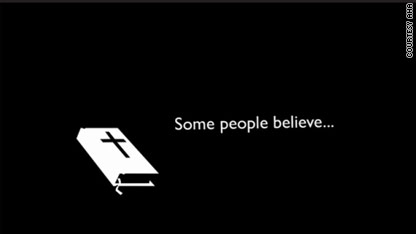
The campaign features violent or sexist quotes from holy books,  contrasted with more compassionate quotes from humanist thinkers, including  physicist Albert Einstein.


A screen grab from the new humanist campaign

"We're calling it like it is," Speckhardt said. "It's quite obvious that  the Bible contains horrific material - and the Quran - and to say you get  your morality from there" is problematic.

"We don't expect to convert people from the billboard signs," he said.

But, he said, "there are millions of people - approximately 34 million  people - who are unaffiliated" with a religion in the United States.

Only one in 20 Americans does not believe in God, according to the Pew  Forum on Religion & Public Life, and of that group, only a quarter call  themselves atheists. The rest say they are agnostic, "nothing in particular" or members of a faith.

More than half of all Americans pray every single day - as do more than  one in five Americans who say they're not affiliated with a religion, according to Pew's U.S. Religious Landscape Survey.

Speckhardt knows the numbers.

"There has only been one member of Congress in the history of the United  States who has come out and said he doesn't believe in God," Speckhardt said, identifying the legislator as Rep. Pete Stark, D-California.
The Secular  Coalition for America said Stark responded in 2007 to an inquiry from that  group by saying he was a "nontheist."

"We feel those (unaffiliated) folks don't yet know they can admit that  they don't believe in God," Speckhardt said.

Marketing guru Allysen Stewart-Allen thinks the campaign has potential.

"They will certainly get people talking," she said.

"One of the things that the humanists need to articulate is what success  looks like for the campaign - if it's converts, I wouldn't think that is a realistic measure," said Stewart-Allen, the director of International Marketing  Partners.

"I would hope what they want is for people to talk about faith in the  widest sense, and I think they will achieve that," she said.

"If your objective is to shape the conversation, I think it can't hurt,"  she added.

21 February 2010

The world’s most prosperous (and happiest) countries are also its least religious, new research states.

Found this interesting article. I did have to emphasize something in the article based on intellectual honesty. However, it's pretty clear when you look at data that goes back years. It's been said quite often, and this confirms it more:

Who Needs God When We’ve Got Mammon?

From Dostoyevsky to right-wing commentator Ann Coulter we are warned of the perils of godlessness. “If there is no God,” Dostoyevsky wrote, “everything is permitted.” Coulter routinely attributes our nation’s most intractable troubles to the moral vacuum of atheism.

But a growing body of research in what one sociologist describes as the “emerging field of secularity” is challenging long-held assumptions about the relationship of religion and effective governance.

In a paper posted recently on the online journal Evolutionary Psychology, independent researcher Gregory S. Paul reports a strong correlation within First World democracies between socioeconomic well-being and secularity. In short, prosperity is highest in societies where religion is practiced least.

Using existing data, Paul combined 25 indicators of societal and economic stability — things like crime, suicide, drug use, incarceration, unemployment, income, abortion and public corruption — to score each country using what he calls the “successful societies scale.” He also scored countries on their degree of religiosity, as determined by such measures as church attendance, belief in a creator deity and acceptance of Bible literalism.

Comparing the two scores, he found, with little exception, that the least religious countries enjoyed the most prosperity. Of particular note, the U.S. holds the distinction of most religious and least prosperous among the 17 countries included in the study, ranking last in 14 of the 25 socioeconomic measures.

Paul is quick to point out that his study reveals correlation, not causation. Which came first — prosperity or secularity — is unclear, but Paul ventures a guess. While it’s possible that good governance and socioeconomic health are byproducts of a secular society, more likely, he speculates, people are inclined to drop their attachment to religion once they feel distanced from the insecurities and burdens of life.

“Popular religion,” Paul proposes, “is a coping mechanism for the anxieties of a dysfunctional social and economic environment.” Paul, who was criticized, mostly on statistical grounds, for a similar study published in 2005, says his new findings lend support to the belief that mass acceptance of popular religion is determined more by environmental influences and less by selective, evolutionary forces, as scholars and philosophers have long debated.

In other words, we’re not hardwired for religion.

Paul also believes his study helps refute the controversial notion that the moral foundation of religious doctrine is a requisite for any high-functioning society – what he dubs the “moral-creator hypothesis.”

Phil Zuckerman, a sociologist at Pitzer College whose research looks at the link between religion and societal health within the developed world, agrees with that assertion. “The important thing we’re seeing here is that progressive, highly functional societies can answer their problems within a framework of secularity. That’s a big deal, and we should be blasting that message out loud,” he contends.

Zuckerman says the findings are consistent with his own data, collected for his 2008 book Society Without God: What the Least Religious Nations Can Tell Us About Contentment — a portrait of secular society in Denmark and Sweden — and his forthcoming Faith No More: How and Why People Reject Religion.

Scandinavian countries, in particular, have achieved high levels of economic strength and social stability, and yet the influence of religion there is in steep decline, perhaps the lowest in recoded history. Coincidence or not, those countries also rank among the world’s happiest populations. In The Netherlands’ Erasmus University Rotterdam’s annual World Database of Happiness the same Northern European countries that score low in religiosity rank high in reported levels of happiness. (The U.S ranked 27th).

What’s their secret? Zuckerman believe it lies in the historically strong sense of community — perhaps a survival response to long, harsh winters – that transcends religious life in these northern climates. Social well-being, economic strength (and happiness) are products of community interaction, not faith, Zuckerman conjectures.

If that’s true — and other researchers, such as influential Yale psychologist Paul Bloom, are touting the idea that mass religion’s greatest value lies in the web of personal interaction it weaves — then societies that reject religion may suffer if strong secular institutions are not in place to maintain community bonds and foster positive civic associations. Social interactions both inside and outside church structure, Bloom recently wrote, is far more beneficial than “a belief in constant surveillance by a higher power.”

Indeed, researchers in a variety of other studies are targeting the positive effects of church-based social interaction. One study published earlier this year in the Journal of Happiness Studies concluded that the quality and depth of personal relationships has a far greater effect on children’s happiness than does religious practice itself — church attendance, prayer, meditation. In many American communities, organized religion is the principal conduit to those kinds of close relationships, as well as to civic action and problem-solving.

Zuckerman warns against hasty emulation of the Danes and Swedes. “We can’t just say that secularity is good for society and religion is bad,” he warns. “And nor can we say the opposite. The connections are very complex.”

Paul is less compromising, characterizing organized religion, particularly the conservative Christian brand widely practiced in the U.S., as societal anathema, conspiring against real progress.

In his paper, Paul writes of an “antagonistic relationship between better socioeconomic conditions and intense popular faith” derived from fear that greater prosperity will loosen the grip of religion. That antagonism, though subtle, is evident in the debate over health care, he argues, noting the intense opposition of such groups as the Christian Coalition to universal coverage and other progressive, European-style fixes.

“These groups have a lot to lose in these kinds of debates. When you adopt progressive policy reforms,” Paul says, “in the long run, religion is bound to be road kill.”

Paul, 54, lives in Baltimore and is not affiliated with any university or think tank. He is largely self-taught. He has published three respected books on paleontology, claiming naming rights to a handful of species, and he earns a living as an artist and illustrator of prehistoric creatures. He migrated to the field of secular studies to wage a kind of scholarly assault on the right-wing fundamentalists who challenge both the evolutionary assumptions of paleontology and, it follows, his livelihood.

He isn’t shy about promoting progressive policy reforms and is quick to blame the Christian right for a range of societal dysfunctions. (A recent study published in the journal Reproductive Health found that states whose residents have more conservative religious beliefs have higher rates of teenagers giving birth).

Yet in spite of his findings, and his secularist agenda, Paul stops short of proposing measures to suppress the role and influence of religion in America. Why? It’s already happening, he insists. Although we remain largely a nation of believers, our faith and commitment are slipping. Religious affiliation, church attendance and belief in God are all in slow decline in the U.S. A recent Gallup poll found that two-thirds of adults believe the influence of religion in American life is waning, up from 50 percent just four years ago.

As these trends continue, he believes, policymaking will more effectively address the true needs of society, rather than the dogma of religious idealism. “People need to know that society without religion is not a bad thing,” Paul says. “And we’re seeing this in other countries. We don’t need religion to have a thriving, prosperous nation.”

21 September 2009

On the Theme of Being Consistently Wrong

Since today is supposedly the end of the world as we know it, here's another post. Actually, I am reposting an essay by Austin Cline, but wanted to add in a few of my own comments first. Basically this is about how often theitards challenge science in the court of law. Now, I guess if the basis and foundation of your belief is under threat from reality (i.e. science), then the court of law is as good a place as any to start. After all, unlike science, the court of law has a much more lax standard of evidence. Human actions and presedence not based in reality can be used to sway judge to the side of the plaintifs. All you need is a really charismatic attorney that can convince another human being of their point of view... as long as that point of view isn't full of shit I guess...

So, in the spirit of theists being so abhorrently and consistently wrong, I give you:

Evolution & Creationism Court Cases - History of Evolution Court Cases
Major Cases & Rulings on Evolution & Creationism in the Federal Courts


In addition to usually losing political fights, creation science supporters also lose in the courts as well. Regardless of what arguments they try to use, the courts inevitably find that teaching creationism is a violation of the separation of church and state because creationists are unable to avoid the fact that their ideology is fundamentally religious and, therefore, inappropriate to teach students in public schools. Only science is appropriate for science classes and that's evolution.

Supreme Court Decisions
The first case came in 1968: Epperson v. Arkansas was over an Arkansas law prohibiting both the teaching of evolution and the adoption of text books which included the concept of evolution. When a Little Rock biology teacher found that a text book adopted by the local school board included evolution, she was faced with a difficult dilemma: she could either use the book and violate state law or she could refuse to use the text and risk disciplinary action from the board itself. Her solution was to remove the problem by getting rid of the law.
When the case reached the Supreme Court, the justices found that the law was impermissible because it violates the Establishment Clause and prohibits the free exercise of religion. Its only purpose was to prevent the teaching of a scientific concept which conflicted with doctrines of fundamentalist Protestant Christianity. As Justice Abe Fortas wrote:
There is and can be no doubt that the First Amendment does not permit the State to require that teaching and learning must be tailored to the principles or prohibitions of any religious sect or dogma.

This decision prevented schools from banning evolution in public schools, so creationists sought another way to stop "godless" evolution: "scientific creationism." This was designed to challenge evolution in the science classes without appearing to be religious. Creationists worked for the passage of "balanced treatment" laws mandating the teaching of creation science whenever evolution was taught. Arkansas again took the lead with Act 590 in 1981 mandating "balanced treatment" between evolution and creation science
A number of people, including local clergy, sued under the argument that this law impermissibly caused the government to give special support and consideration to one type of religious doctrine. A federal judge found the law unconstitutional in 1981 and declared creationism to be religious in nature ( McLean v. Arkansas).
Creationists decided not to appeal, pinning their hopes on a Louisiana case they thought they had a better chance of winning. Louisiana had passed a "Creationism Act" preventing evolution from being taught unless biblical creationism accompanied it. Voting 7-2 in Edwards v. Aguillard, the Court invalidated the law as a violation of the Establishment Clause. Justice Brennan wrote:
...the Creationism Act is designed either to promote the theory of creation science which embodies a particular religious tenet by requiring that creation science be taught whenever evolution is taught or to prohibit the teaching of a scientific theory disfavored by certain religious sects by forbidding the teaching of evolution when creation science is not also taught. The Establishment Clause, however, "forbids alike the preference of a religious doctrine or the prohibition of theory which is deemed antagonistic to a particular dogma."Because the primary purpose of the Creationism Act is to advance a particular religious belief, the Act endorses religion in violation of the First Amendment.


Lower Court Decisions
The debates continue in the lower courts. In 1994 the Tangipahoa Parish school district passed a law requiring teachers to read aloud a disclaimer before teaching evolution. The 5th Circuit Court of Appeals found in Freiler v. Tangipahoa that the stated "critical thinking" reasons for the disclaimer were a sham. Even if a valid secular purpose for the disclaimer existed, though, the court also found that the actual effects of the disclaimer were religious because it encouraged students to read and meditate upon religion in general and the "Biblical version of Creation" in particular.
Another creationist tactic was tried by biology teacher John Peloza in 1994. He sued his school district for forcing him to teach the "religion" of "evolutionism." The Ninth Circuit Court of Appeals complete rejected all of Peloza's arguments in Peloza v. Capistrano. They found that his arguments were inconsistent - sometimes he objected to teaching evolutionary theory, sometimes he objected to teaching evolution as a fact — and held that evolution is in no way a religion and has nothing to do with the origins of the universe.
Webster v. New Lenox School District was decided in 1990 by the 7th Circuit Court of Appeals. Ray Webster had been instructed not to teach creation science in his social studies class but he filed suit and claimed that the New Lenox School District violated his first and Fourteenth Amendment rights by prohibiting him from teaching a nonevolutionary theory of creation in the classroom. The court rejected each of his allegations and established that school districts can forbid creationism as a form of religious advocacy.
Creation scientists have failed in their attempts to have evolution legally banned from the classroom or to have creationism taught alongside evolution, but politically active creationists have not given up — nor are they likely to.
Creationists are encouraged to run for local school boards to gain control over science standards, with long-term hopes of diluting and eliminating evolution through slow attrition. This need only happen in a few areas to be successful because some states command a larger share of the market for school text books than others. If the text book publishers cannot easily sell books with a strong emphasis on evolution to large markets like Texas, then they are unlikely to go to bother publishing two versions. It doesn't matter where creationists become successful because. in the long run, they may end up affecting everyone.