


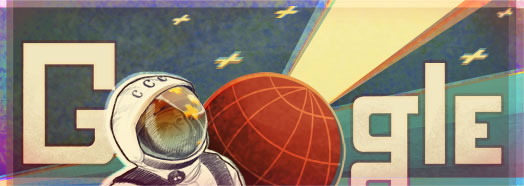
In celebration, Google has a great Google Image. There is also a great film called First Orbit that is out. Go to the First Orbit page and give it a look.



Straight from the American Museum of Natural History:
After hovering over Mount Everest and the gorges that plunge to the Ganges, you are pulled through the Earth’s atmosphere to glimpse the inky black of space over Tibet’s high desert. So begins The Known Universe, a new film produced by the American Museum of Natural History that is part of a new exhibition, Visions of the Cosmos: From the Milky Ocean to an Evolving Universe, at the Rubin Museum of Art in New York City.
The magic of this film, though, happens as the inky black expands. Pulling farther and farther from Earth, you see the deep blue of the Pacific give way to night as the Sun comes into focus, the orbits of the solar system shrink smaller and smaller, the constellations Sagittarius and Scorpio stretch and distort, and, as the Milky Way receeds, the spidery structure of millions of other galaxies come into view. Then, you reach the limit of the observable universe, the afterglow of the Big Bang. This light has taken more than 13.7 billion years to reach our planet, and you return, back to Earth, to two lakes that are nestled between Mount Kailash and Mount Gurla Mandhata in the Himalayas.
The structure of The Known Universe is based on precise, scientifically-accurate observations and research. The Hayden Planetarium at the American Museum of Natural History maintains the Digital Universe Atlas, the world’s most complete four-dimensional map of the universe. The Digital Universe started nearly a decade ago. It is continually updated and is the primary resource for production of the Museum’s Space Shows such as the current Journey to the Stars, and is used in live, real-time renderings for Virtual Tours of the Universe, a public program held on the first Tuesday of every month. Last year, some 30,000 people downloaded the Digital Universe to their personal computers, and the Digital Universe will soon be updated with a more accurate and user-friendly software interface. Digital Universe is licensed to many other planetariums and theaters world-wide.
“I liken the Digital Universe to the invention of the globe,” says Curator Ben R. Oppenheimer, an astrophysicist at the Museum. “When Mercator invented the globe, everyone wanted one. He had back orders for years. It gave everyone a new perspective on where they live in relation to others, and we hope that the Digital Universe does the same on a grander, cosmic scale.”
The new film was produced by Michael Hoffman, and directed by Carter Emmart. Brian Abbot manages and Ben R. Oppenheimer curates the Digital Universe Atlas. The exhibition at the Rubin, Visions of the Cosmos: From the Milky Ocean to an Evolving Universe, opened on December 11 and continues through May 10.
 I don't know about you, but I love shuttle launches. It's just something to consder that we are sending humans into space! Say what you will about the United States (and Russia and China), but putting people into orbit is an impressive feat. And for all those that say the manned space program is a waste, I suggest you only do all your air travel from this day forward on robotic air carriers, and let robots drive you to and from work every day. There are just some things that require a human brain!
 Just saw that we've nailed down how fast we're flying apart from the rest of the universe, and it just made me think of a particularly funny song from "Monty Python and the Meaning of Life". Actually, in thinking about it, it does seem that the most recent and dramatic philosophisers on the "Meaning of Life" have come from the UK. Monty Python, Douglas Adams, and even someone like Dawkins!
